



WARWICK – When it comes to affording to live in the Ocean State, it’s become more sink than swim for a disproportionate number of Rhode Islanders.
Working hard to make ends meet, nearly half of the state is still in the situation of finding it difficult to afford life, and they’re often forgotten when talking about need, say representatives from United Way of Rhode Island.
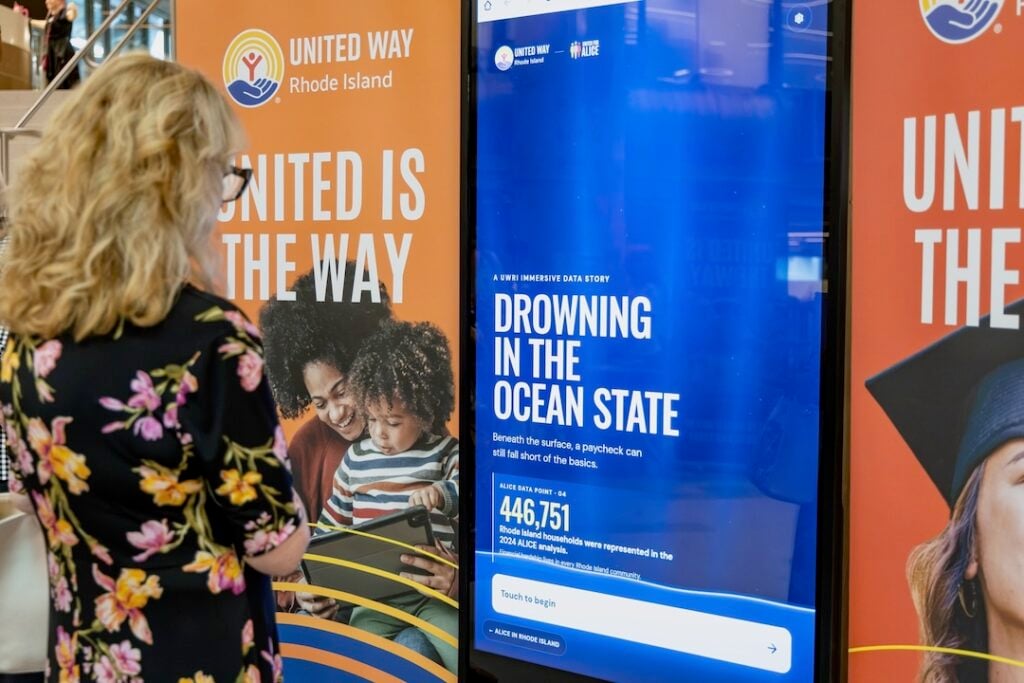
Today, 43 percent of Rhode Island households are experiencing financial hardship and cannot afford basic necessities, despite working, earning, raising families, and contributing to their communities, says new data.
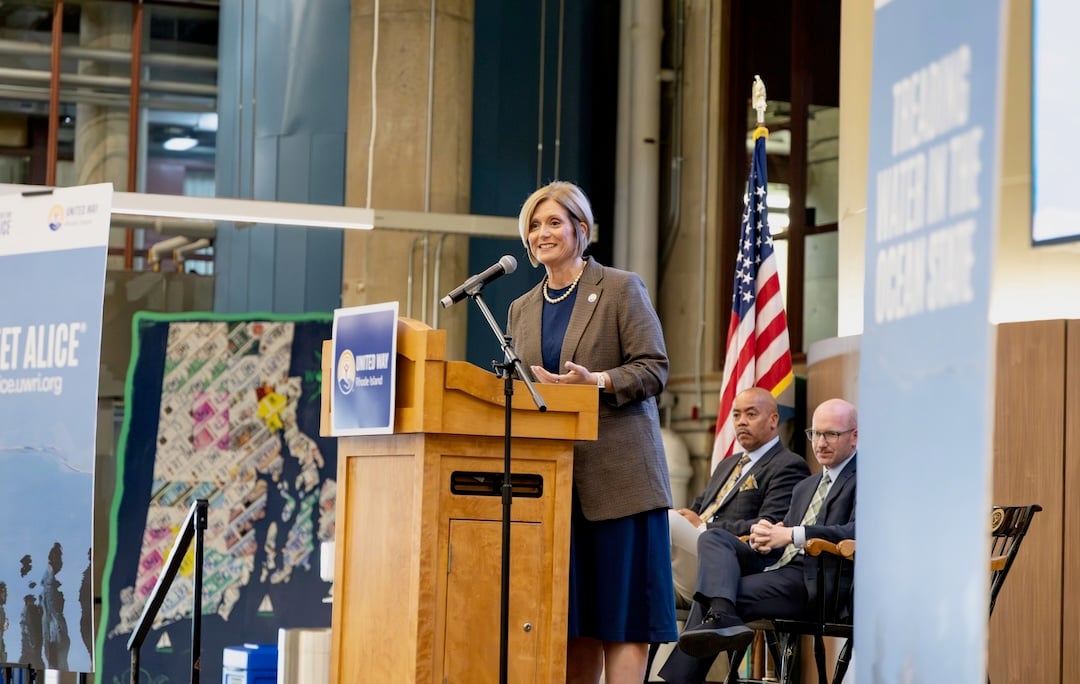
The statistic is a finding in ALICE in Rhode Island: A Study of Financial Hardship, released Thursday by UWRI during an event at CCRI’s Warwick campus. The report is a comprehensive, evidence-based depiction of financial need in the state, offering an accurate lens of the economic reality facing hard-working Rhode Islanders.
ALICE, which stands for Asset Limited, Income Constrained, Employed, is an economic condition representing households that earn above the federal poverty level but do not earn enough to afford the essentials where they live. Rhode Island is the 41st state in the country to join the national United for ALICE movement.
“If a person works full-time, it should be enough to provide the basics for their family, but that simply isn’t the case,” said Cortney Nicolato, president and CEO of UWRI. “Each and every one of us know ALICE; ALICE is the recent college graduate unable to afford to live on their own, the young family strapped by child care costs, the underemployed mid-career professional, and the blue-collar workers essential to keeping our state and our economy functioning. It is time that we reconsider who we think about when we picture a struggling neighbor.”
Among northern Rhode Island communities, Central Falls has 75 percent of households below the ALICE threshold, Pawtucket has 54 percent in that position, Woonsocket has 58 percent, and the village of Harrisville CDP (census designated place) has 55 percent, and Foster CDP has 47 percent. Some 53 percent of Providence households are in that position, and 47 percent of East Providence households are.
For decades, federal poverty data has been used to define financial hardship. In 2026, the federal poverty level for a family of four is $33,000. According to research for the ALICE in Rhode Island report, a family with two working adults and two young children would need to earn $111,000 annually to afford the basics here. That budget, outlined in the report, is calculated as a “survival budget,” meaning it does not account for unexpected expenses such as vehicle or home repairs, extras like vacation and dining out, and saving.
“A number developed in 1963 is what’s used to determine who is eligible for assistance and who is told ‘they earn too much,’” added Nicolato. “The federal poverty level was an estimate that took what the government considered an ‘emergency’ food budget and multiplied it by three, because in that time, food was one-third a family’s budget. It entirely ignores generations of rising costs of housing, child and health care, transportation, even taxes. ALICE lets us see what poverty measures miss.”
This is bigger than one organization, Nicolato said, but about people who are working hard and still struggling to meet their most basic needs. The flowing current against them keeps getting stronger, she said, as costs for everything go up and the math no longer works.
For far too long, she said, working families have been blamed and shamed for supposed personal failures that were never their fault. For the first time, ALICE presents the truth with data, creating a language for “households hiding in plain sight,” said Nicolato. This shifts the paradigm to figure out how to help people get out of a cycle of being one big unexpected bill away from disaster. It’s important, said Nicolato, to not just name the problem, but set a path toward changing the narrative for people and families..
She shared how she came from one of those ALICE families from Pawtucket, where there was no room for error and a medical leave changed her family. Her family stayed postive, stayed focused, but were always stuck in that vicious circle.
She said donors who contribute to United Way and its work on this and other programs will help families get ahead and live out their dreams. She noted how UWRI has led the way by setting a new floor of $23.50 per hour for work, on a path to $25. It will take elected, nonprofit, and business leaders working together and thinking differently on everything from wages to policies on work leave to help working families gain stability, she said.
At a glance
The ALICE in RI: A Study in Financial Hardship report reveals that :
- 190,530 Rhode Island Households, 43 percent of the state’s total, are below the ALICE threshold.
- A family of four needs $111,000 a year to afford a basic household “survival” budget.
- 63 percent of Hispanic households and 56 percent of Black households fall below the ALICE threshold.
- In the workforce, 76 percent of childcare workers, 64 percent of construction laborers, and 50 percent of cashiers, waitstaff, and landscapers are ALICE; all are among RI’s ten largest industry sectors
- 64 percent of households headed by people 65 and over are ALICE, a demographic that is already the fastest-growing age group in the state.
The poverty line, Nicolato said, was developed in the 1960s by a “rockstar” of a woman, Mollie Orshansky, but it was based around food costs as a percentage of a total budget, and it’s a standard that’s abused today.
Nicolato asked those in attendance what they will do personally to change the game for these people who are our friends and neighbors, working hard each day to make the state run. No one should feel as if they’re drowning, she said, and we need to stop counting who’s falling behind and start building a Rhode Island where working works for everyone.
“ALICE is consistently forced to make difficult decisions that compromise health and safety to try and make ends meet, and that not only holds families back, but it also prevents our entire state from thriving,” said Kyle Bennett, chief policy and impact officer, for UWRI.
“We need to bring ALICE and this data into our conversations about housing, healthcare, education, policy…everything,” he said.
Bennett shared the story of the Greenman family of Pawtucket putting an extension cord to a neighbor’s house to make sure they had electricity until it could be turned back on.
Adam Greenman, previously of UWRI and now mayor-elect of Pawtucket, said he sees this situation all the time in that city. He shared how those neighbors, with both parents working full-time jobs, had their car break down and had to make a choice between their utility bill and getting the car fixed. They made the choice to defer the electric bill, and when RI Energy was allowed to turn of the power in May, the utility did so, he said. Working with United Way and its 211 hotline, they were able to get the family’s power restored within two days, he said, and they were thankfully able to get back on track, but they ended up moving away after their rent went up.
That family is ALICE in a nutshell, said Greenman, and when they first started talking about this concept a decade ago, it was for those types of people that they wanted to help to create a Rhode Island that’s better for everyone.
The work, he said, is going to take everyone in every sector stepping up, but this data defines the goal.
Melissa Cherney, president and CEO of the Rhode Island Community Food Bank, shared about her experience at a local grocery store a few days earlier, where she said she encountered an older man watching the screen as the bill hit $110 for one bag of groceries and expressing relief that it was within his budget and hi might be able to buy a rotisserie chicken as well.
The cashier, named Alice, then responded that she doesn’t get paid until Friday, and would then be able to buy groceries, she said, adding that it’s sometimes difficult to work in a grocery store with so much food around her and not have that same food at home.
There is no typical face of hunger, said Cherney, who described how 102,000 Rhode Islanders stood at a food bank or meal site last November. People are making impossible choices, she said, not making enough to afford basic costs of living but not poor enough to be considered in poverty.
The ALICE report shows that there’s no single cause of financial hardship, she said, and there can’t be a single solution. ALICE households have always been here, she said, and now there’s data to be able to see them and do something about it.
As UWRI nears the end of its centennial year and prepares for its next century of service to Rhode Islanders, ALICE data will help to drive the organization’s new strategic plan, community investments, and advocacy efforts.
The organization will work closely with employers on ALICE@Work, helping them understand and respond to the financial realities facing their workforce, enlisting their support and commitment to ALICE. Collaborations with nonprofits and funders will identify unmet need and help target investments to create the biggest impact, lifting families from insecurity to stability.
Visit unitedwayri.org for more on UWRI.