



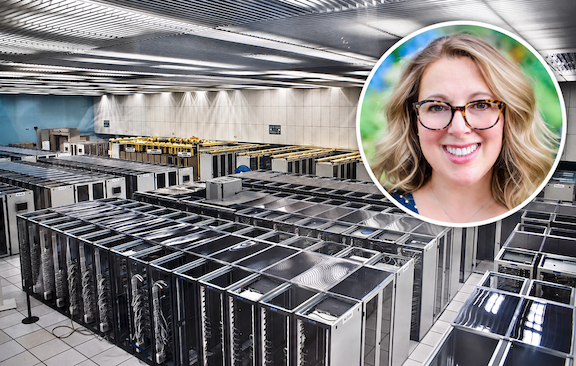
CUMBERLAND – A single data center can use the equivalent energy of 16,000 households, almost the 17,500 total in Cumberland, and have wide-ranging negative impacts, says Town Councilor Jodi Harrington-Sweet.
The council, on Wednesday, Sept. 16, passed her ordinance placing data centers as a prohibited use within the town’s zoning ordinance, effectively banning them.
This move doesn’t have to be permanent if new and less impactful approaches are found in the future, Harrington-Sweet told her colleagues and the public, but for now, there’s no question that data centers amid the AI boom are hurting communities in so many ways. Cumberland, she emphasized, shouldn’t be one of them.
The vote to prohibit such centers in town was 6-1, with Councilor Peter Bradley opposed. The ordinance subcommittee had voted to advance the measure, with Councilor Jim Metivier dissenting at that point.
Cumberland joins nearby Smithfield and Lincoln in banning such facilities.
Harrington-Sweet says she’s spent months researching and talking to people about this topic, and it was great to see the effort produce something that protects Cumberland during a time when data centers “are barreling ahead with little to no guidance on how we protect communities, our wallets, and our environment.”
She thanked the Planning Department for making the idea come to life.
Harrington-Sweet shared how she saw the challenges Smithfield was facing with a proposed data center and having no pre-existing rules. Knowing that such an impactful development could be squeezed through there, and finding that the state isn’t doing much to protect communities with most bills sitting in committee, she said she decided to take action on the local level.
She pointed to a memo from the planning staff supporting the move and describing how it would fit into the town’s goals to protect natural resources, promote sustainable energy production and use, and sustain the community’s high quality of life and unique attributes.
“With the exponential growth of AI as a tool over the past decade at both enterprise and individual levels, data centers have emerged as a type of infrastructure that many tech companies in the U.S. require to operate competitively,” wrote staff. “While there is growing support federally for the development of these facilities due to the perceived economic benefits, there are serious environmental and public health concerns related to the operation and maintenance of data centers have have negative impacts on the communities that host them.”
Harrington-Sweet noted that these facilities consume more energy than an entire small city in one day, emphasizing how a state such as Virginia has subsequently seen energy rates jump 267 percent in five years. Rhode Island already has some of the highest rates in the country, she said, and citizens can’t bear the cost of subsidizing large-scale corporations.
In discussing comparisons between a data center and the town as a whole, she said water consumption is also a huge concern. From June of 2025 to May of 2026, the area received 80 percent of its normal rainfall, and many local waterways haven’t had their typical water flow in years.
Cumberland, she said, would need a “massive overhaul of infrastructure” to handle the water consumption needs from a data center.
Harrington-Sweet highlighted the situation in Lowell, Mass., where a 352,000-square-foot data center in an old spaghetti factory adjacent to a residential neighborhood is pouring diesel fumes from 27 industrial backup generators and 16 cooling centers, as well as intense noise, into surrounding properties. They’re looking to expand those 27 generators to 81, she said, and the only reason they haven’t yet is because the neighborhood is suing them. She said the black wall from the data center looms over homes like some sort of dystopian sci-fi reality.
She shared how the state of Rhode Island was trying to offer developers tax credits to create these types of facilities, even as they pollute the environment, raise electric bills, and drain resources, all while raising electric bills and providing only temporary construction jobs.
No ordinance or law is forever, she said, and if and when centers cause less harm, the town could change its position. Right now, she said, officials need to protect the town.
Resident Cheryl Jones Head said the impact from data centers is “horrific,” adding that she’s glad the town is doing something about this. She said there is no upside from such developments that accept massive tax breaks, and it’s “insane” to give them any benefits.
Brendan Downey, of Rhode Islanders for Personal Privacy, quoted poet William Blake writing many years ago about the “dark satanic mills polluting the once-verdant countryside,” and he said he can’t help feel the same way today as he watches situations unfold in Lowell and elsewhere. Both the factories of old and modern data centers cause catastrophic environmental damage and immense strain on municipal resources, he said, not to mention environmental effects amid a climate crisis or the selling of data that happens for profit. Why willingly add to those problems, he said, driving up bills for residents and causing “massive strain” for little reward in return. He urged the council to keep Rhode Islanders safe from these modern “dark, satanic mills.”
John Downey, of Climate Action Rhode Island and Rhode Islanders for Personal Privacy, said data centers present a net negative for communities, spewing methane and toxins, further adding to the climate crisis and causing energy rates to climb. He said they consume the energy of anywhere from 10,000 to 200,000 homes, as the bill and health impacts are delivered to “average Joe” The water consumption needs are “unforgivable” in a continuously heating world, he said, and the noise effects are persistent and torturous.
Councilor Bob Shaw thanked Harrington-Sweet for her efforts.
Councilor Lisa Beaulieu compared the current situation to back when solar power was becoming big in Rhode Island and woodlands were being clear-cut as a result. Just as then when there was conflict between balancing clean energy needs and decimating open space and things settled down when communities started speaking up, she said, this is good timing and a great move knowing some of the changes the state will look to place on communities.
Beaulieu mentioned a proposal along the Merrimack River in New Hampshire to convert a decommissioned coal-fired power plant into a data center, which similarly to local hydro projects along the Blackstone River in Cumberland and Lincoln, was uncovered by local residents concerned about the impact to the river.