



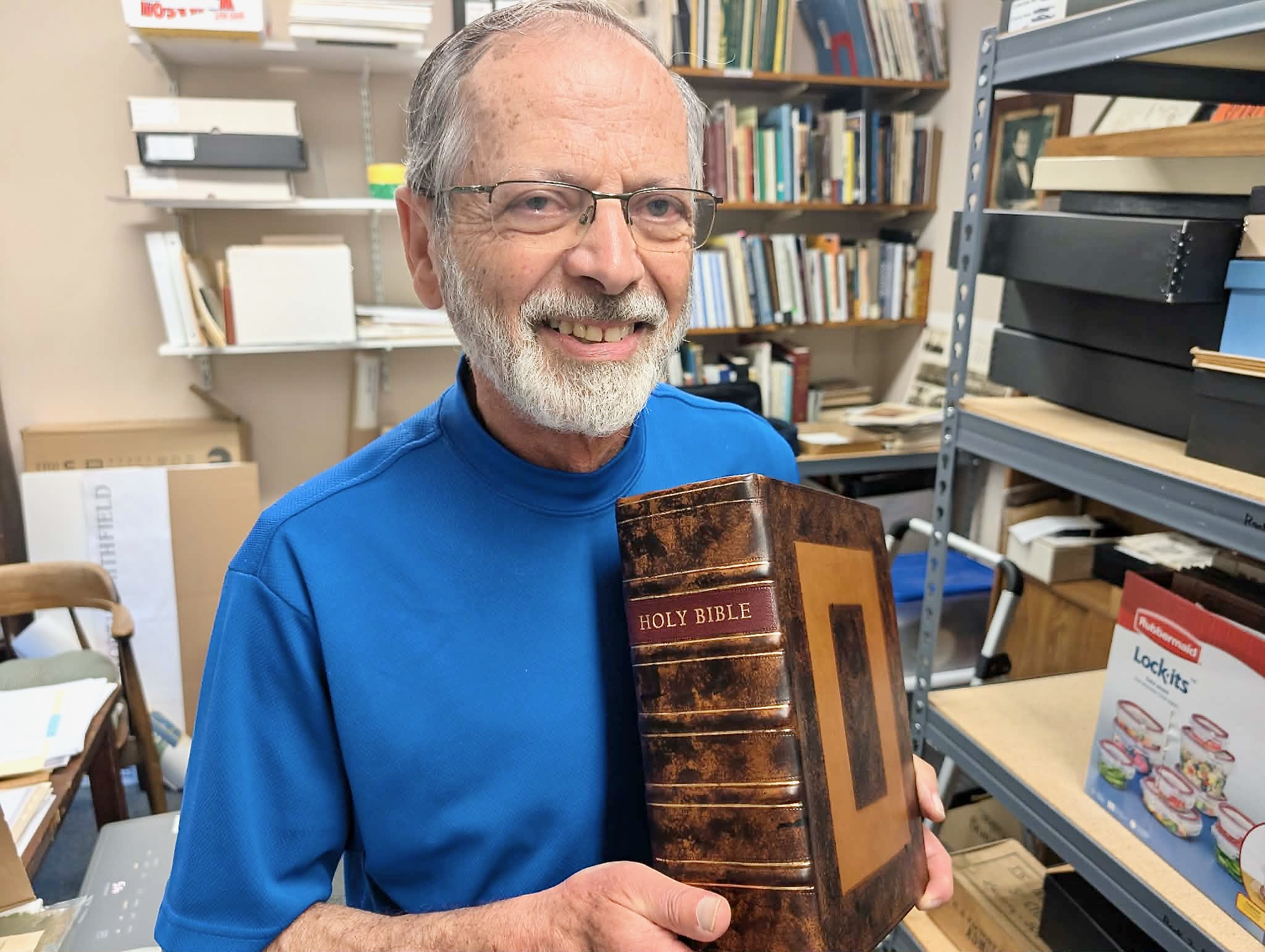
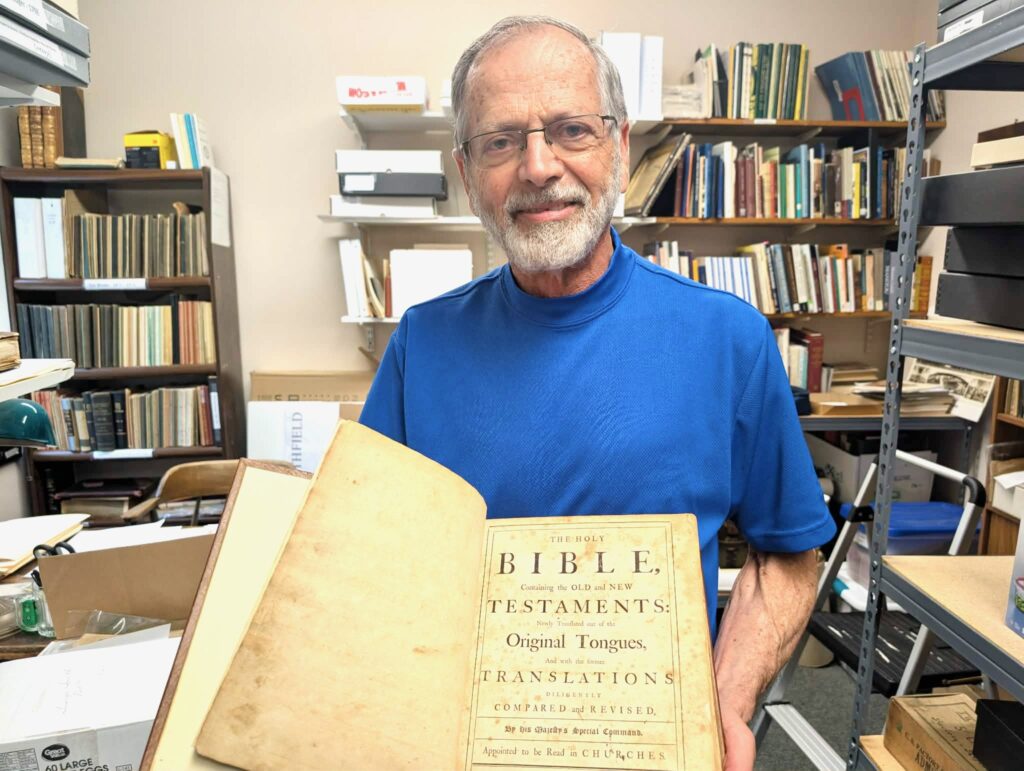
NORTH SMITHFIELD – One of the North Smithfield Heritage Association’s oldest artifacts, a 1761 royal-authorized Thomas Baskett Bible, has now been meticulously restored by a local preservation expert, say members of the NSHA.
Al Menard, archivist for the preservation group headquartered at the Memorial Town Building, said it is a privilege to have this rare edition of the Old and New Testaments, and they’re so happy with how the large Bible has been preserved.
The book is distinguished as the first larger-sized Bible designed for churches, lecterns, or prominent family displays. Some such volumes are recognized for their legible typography, robust bindings, and refined page layout.
The NSHA ran a fundraiser to gain the $800 needed to fund the restoration and newly stitched binding by George and Patricia Sargent, of Dragonfly Bindery/Studio on Park Avenue in Woonsocket.
A note with the Bible, which was acquired by the NSHA back in the early 1970s, had the name of a George Smith. Though they were able to find a locally famous politician named George Smith from the time, it’s hard to say, based on how common the name was, if he was the same one on the note, said Menard. Smith is a very common name in town, he said.
Back then, said Menard, they didn’t have a physical building, so many items were stored temporarily in local homes. Over time, some of those items were effectively lost, as recipients forgot where they came from and absorbed them into their own belongings. There are still items such as a gown and mirror that Menard said he’s hoping will turn up.
The Bible will be on display at Heritage Hall this September as part of a Daughters of the American Revolution exhibit celebrating the nation’s 250th anniversary. All donors to the restoration project will be recognized at the official unveiling.
The NSHA Bible was published by Thomas Baskett, son of the King’s Printer, John Baskett, who began printing Bibles in London in 1711. Thomas succeeded his father as both the head of the printing house and as the King’s Printer. The King’s Printer was responsible for producing Bibles, prayer books, and official state documents in Oxford and London. The Baskett family maintained a prominent position in the Bible-printing industry for several decades, issuing numerous editions of the authorized (King James) version, which had served as the standard English Bible since 1611.
Baskett’s Bibles were widely distributed in Britain and the American colonies, significantly impacting religion and literacy, according to a summary by Menard. Their editions are so notable that collectors have traced them for centuries.
Before independence, it was illegal to print English-language Bibles in the colonies because the Crown gave exclusive printing rights to the King’s Printers, including the Basketts. Therefore, colonial families had to import their Bibles from London or Oxford in England.
The NSHA’s 1761 edition is one of the final Bibles printed by Thomas Baskett, as he died that same year. It represents the culmination of the Baskett family’s craftsmanship and the Oxford press’s 18th‑century standards, said Menard.
“We see our 1761 Baskett Bible as a link to colonial times, especially its religious life,” he said.
A household Bible printed by the King’s Printer would have been a central devotional object in 18th‑century New England. The book is also an example of trans-Atlantic trade of the time. Its presence in Rhode Island reflects the flow of books, ideas, and culture between Britain and the colonies.
“Owning a Bible printed under royal privilege, just 15 years before independence, captures the tension between British authority and emerging American identity,” he said. “Our 1761 Baskett Bible is therefore exactly the kind of imported, royal‑authorized Bible that would have sat in New England homes on the eve of the Revolution.”
The ongoing restoration of the Memorial Town Building as a future museum for local history is progressing, and further grants will be sought to continue replacing the large windows upstairs. Two have been replaced already, at $10,000 apiece, and four more will be done.
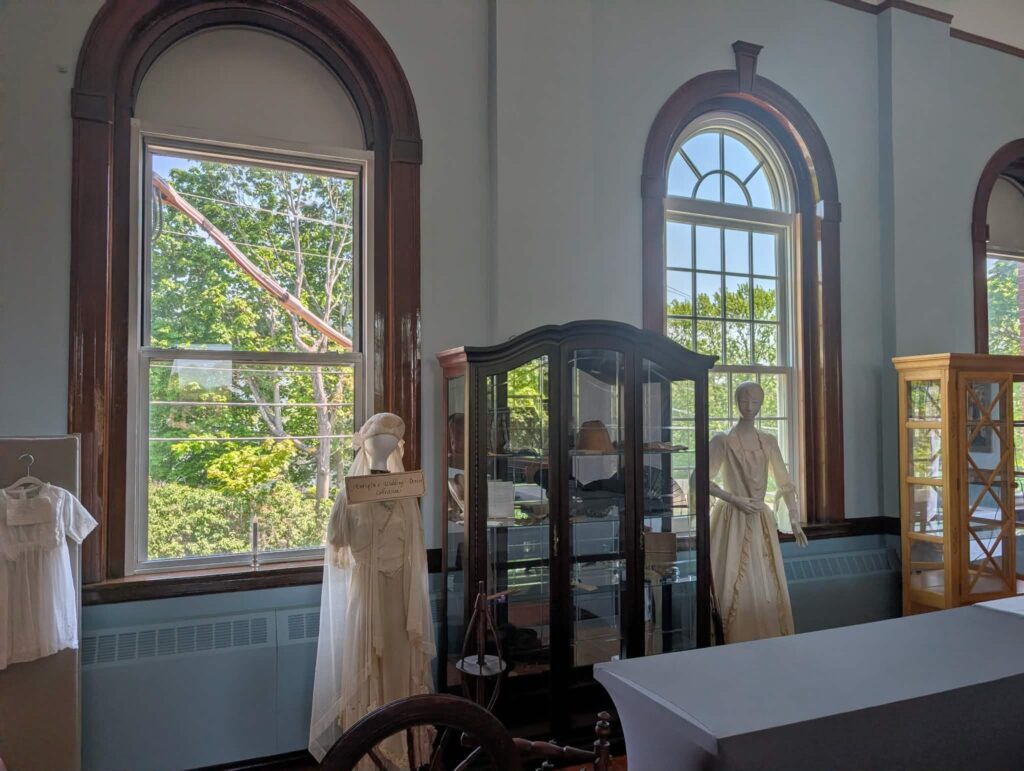
Menard said they’re very happy about what the space is becoming, including a special case for an 1842 Dorr Rebellion flag, and looking forward to people seeing the many restored items important to North Smithfield’s past.