



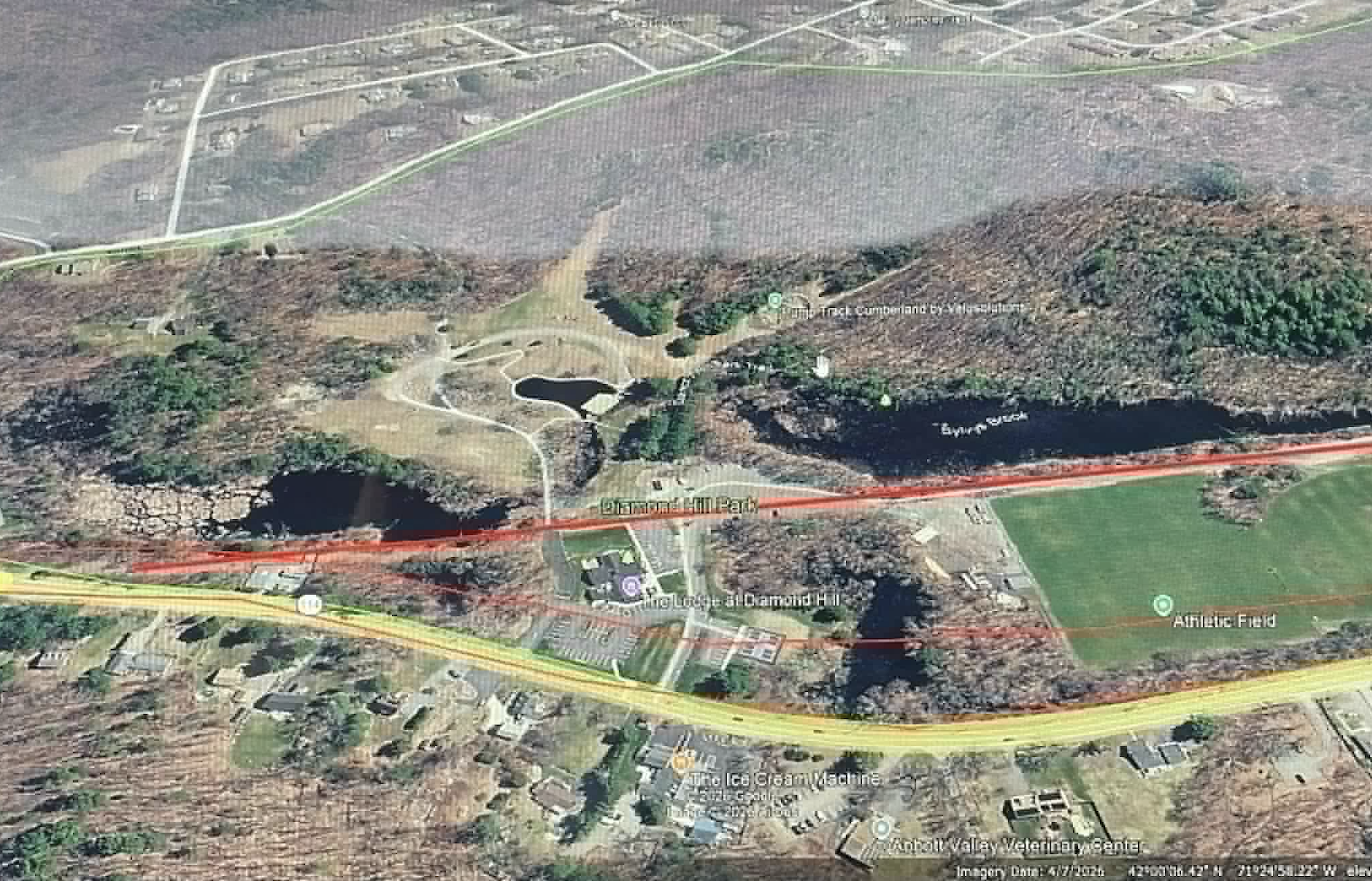
CUMBERLAND – Residents in the northeastern-most part of town, in the area of Diamond Hill Park, concerned about plans to expand a gas line through the area, including through their properties and a town park that has received significant recent upgrades.
According to notices to residents in Cumberland, a large work zone will be created around the pipeline as the 16-inch line is replaced with a 36-inch pipe from the Wrentham line to around Hannah Drive, and three temporary access roads will potentially be created into Diamond Hill Park.
Algonquin Gas Transmission LLC/Enbridge is continuing to conduct its survey of the area, according to Cumberland officials.
Phil Gouin, who lives next to the park, is warning about the impact of the work, and he and neighbors have expressed concerns about the lack of clarity around how much their private properties will be impacted as plans show the work going right through them.
Gouin told The Local Insider this week that they’re still waiting for concrete information from the company, and that the land agent who was on the project is no longer with the company. Neighbors had big problems with his approach, he said, and remain adamantly opposed to this project.
Gouin said he and neighbors on Cook Road, including Nick and Wendy Deubert and Marie Forte, remain adamantly opposed to this project, and don’t believe it’s necessarily a foregone conclusion that it will happen.
He said he believes construction will make a mess of Diamond Hill Park.
Apart from his own very legitimate concerns about his property, said Gouin, “I am very concerned about environmental impact as most of the route is right up against the water, all part of public drinking water supply,” he said, adding that he recently sent a letter to the Pawtucket Water Supply Board asking how aware they are of the project.
Gouin lives right on Miscoe Lake, just northwest of the Diamond Hill Reservoir at the Massachusetts line.
“I can’t even trim a shrub within 200 feet of the water (I respect that),” he said, adding that his understanding is that the project would possibly clear-cut all vegetation right up to the water’s edge in a strip about 500 feet long.
This is also his concern at Diamond Hill Park where the line runs right up to the water near the soccer fields, he added.
Cumberland Public Works Director Romeo Mendes said this week that the only contact he’s had with Algonquin is their request to go into public property to survey, which the town granted. He said he’s seen 30 percent plans, but hasn’t had a chance to take an in-depth look.
What he has seen, said Mendes, is parts of the pipe in the vicinity of the new Diamond Hill Lodge building, but his understanding is that the company will abandon that part and stay in the back gravel area adjacent to the fields. They’ll put temporary gravel access roads in, he said, then return it to a natural state when finished.
Mendes said he doesn’t expect the work to disturb any of the existing large-scale improvements the town has invested in near the entrance, and it seems he company would have said something if representatives believed their work would have impacted that.
Nick Deubert said this week that there have been red flags with the company since before this project was made official late last year. He said he tried to call about dead trees and the smell of gas then, but got no calls back.
Deubert said his main concern is environmental, and also about the potential loss of white pine trees on their property, trees he’s been working to get designated as Champion Trees. He said he’s refused all surveys of the property. The advice they received in the “No Pipeline Expansion” group they’re part of was to go that route because it will mean the worst-case scenario is that the company will need to take property by eminent domain and it’s their best chance at getting reparations.
Even despite refusing the surveys, Deubert said they’ve had to chase surveyors off their property. He said an environmental representative from the company suggested that the best route to protect the trees on the property was for a cultural survey, which was the only one he agreed to, but said it can only happen when he’s present. The company hasn’t taken him up on that, he said.
“It’s just been a bunch of lip service,” he said of the company.
He said there is no easement to their property, though there is an easement on the old railroad property running between them and their neighbor.
Algonquin Gas Transmission hosted open houses at the Cumberland Library in March, Diamond Hill Lodge in April, and another on May 14 at Coachmen’s Lodge over the line in Bellingham, Mass., for the public to review and comment on the company’s proposed Reliable Affordable Resilient Enhancement, otherwise known as the AGT Enhancement.
Those were held ahead of Algonquin’s anticipated submittal of the its Environment Notification Form this month as part of the Massachusetts Environmental Policy Act.
Algonquin is planning a targeted enhancement of existing pipeline infrastructure designed to upgrade the existing system within, or adjacent to, existing rights-of-way. The work will center around already existing infrastructure and will not require the construction of any new compressor stations, states the company, and is expected to be completed by late 2029, with work starting next year.
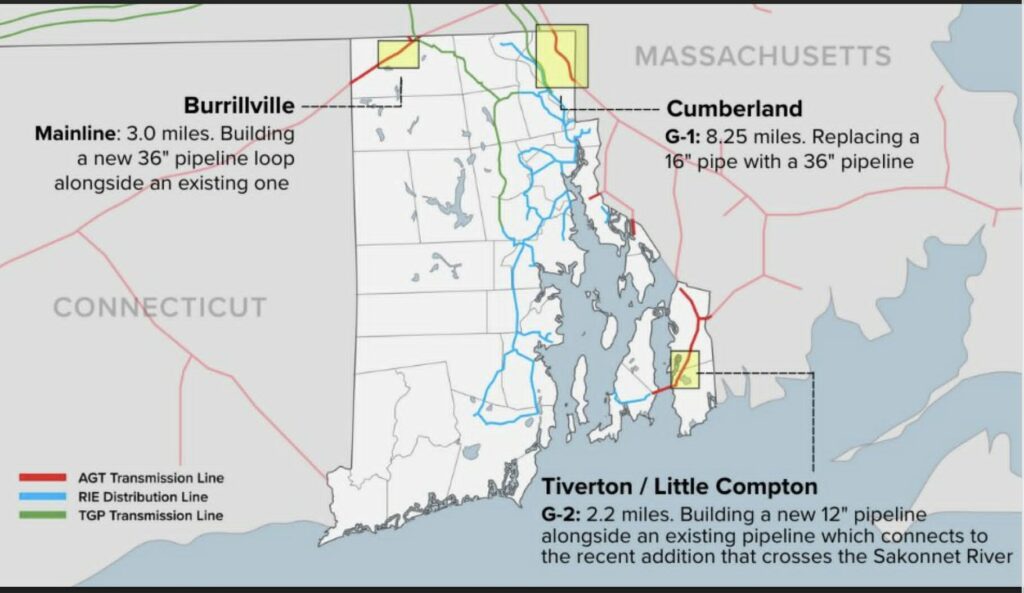
Within Massachusetts, pipeline enhancements will occur in the towns of Mendon, Bellingham, Franklin and Wrentham. Upgrades in Rhode Island will take place in Cumberland, Little Compton, Tiverton and Burrillville.
Algonquin is proposing the following as part of the AGT Enhancement:
• Replacing approximately 8.25 miles of Algonquin’s existing 16-inch diameter natural gas transmission pipeline known as the G-1 pipeline through Worcester and Norfolk Counties, Massachusetts and Providence County, Rhode Island. Of the total 8.25 miles of pipeline replacement, approximately 6 miles of pipeline replacement will be in Massachusetts.
• Extending Algonquin’s 12-inch diameter G-2 pipeline approximately 2.2 miles in Newport County, Rhode Island.
• Installing approximately 3 miles of 36-inch diameter pipeline in Providence County, tying into the Burrillville discharge.
• Completing software modifications at existing compressor station in Cromwell, Conn.
At the spring events, Algonquin assured residents that they would review all views and comments made as part of their plans to the maximum extent possible.
Eco RI published the following story on the plan in February:
Proposed Expansion of Algonquin Natural Gas Pipeline in R.I. Raises Hackles of Residents, Environmental Advocates
By Jonmaesha Beltran and Bonnie Phillips / ecoRI News staff
February 23, 2026

BURRILLVILLE, R.I. – Robert Cote was caught off guard when he received a packet of information detailing an “enhancement” to the Algonquin natural gas pipeline in the mail last fall.
“Why are we promoting natural gas and fossil fuels when there was a real push years ago to move to green energy?” Cote wondered. The retired fifth-grade teacher’s property on Hill Road in Pascoag abuts land with Algonquin easements, and he is worried about how the expansion will affect his homestead.
The Algonquin pipeline pressurizes natural gas to help it move from New Jersey to Massachusetts. Enbridge Inc., the Calgary, Alberta-based company that owns the pipeline, is seeking landowners’ permission to survey their property before construction on a $300 million expansion and upgrade to the pipeline system begins in 2029. The work will include replacing 7.1 miles of the existing 16-inch-diameter natural gas transmission pipeline with a 36-inch-diameter pipeline through Norfolk County, Mass., and Cumberland, R.I.; extending its 12-inch-diameter pipeline 2.2 miles in Little Compton and Tiverton, R.I.; installing 3 miles of a 36-inch-diameter pipeline in Burrillville, R.I., tying into its discharge; and adding software upgrades at a compression station in Connecticut.
Enbridge officials said the project will focus on existing infrastructure by upgrading pipes within or next to existing rights of way and will not require construction at any compressor stations. The company claims that the proposed upgrades will reduce transmission constraints — such as low pipeline flow and limited capacity — that have caused reliability issues and contributed to skyrocketing energy costs across the Northeast.
But environmental advocacy groups and some residents who live near the pipeline have expressed concern that the project is in stark contrast to the state’s mandated Act on Climate goals to lower greenhouse gas emissions.
“These projects would increase the amount of gas moving through the system, extending the life of this infrastructure for decades — without committing to lower energy costs,” Climate Action Rhode Island (CARI) said in an email.
Natural gas is non-renewable and releases greenhouse gases when it’s burned. Much of the natural gas that runs through U.S. pipelines comes from hydraulic fracturing (fracking), which has been found to pollute water and set off seismic activity.
Kathy Martley, who lives on Wallum Lake Road near the Algonquin pipeline compressor station, told ecoRI News when Enbridge first proposed the pipeline expansion that her group, B.A.S.E., fears it would mean more construction, more noise, more smells, and more pollution.
Martley said she worries about how construction may impact the wildlife around the area and increase noise around her neighborhood. Blowdowns, a process of routinely releasing gas and pressure on the pipelines through the compressor stations, already cause loud disruptions, and she worries a pipeline expansion may require more of them.
“We should already be changing over to more sustainable stuff,” said Martley, adding that she believes the state should be moving away from methane and toward cleaner renewable energy.
Right now, said Donald Fox, president of the Burrillville Town Council, there are no plans to hold town meetings on the pipeline project.
“As we go forward, the Town Council will discuss things as they become necessary,” he said. “But you have to keep in mind that this is a federal project, and while they’re going to solicit local input, this is a project that’s going to be driven at the federal level. So our input, of course, is going to be centered around constituent concerns.”
CARI is holding a series of presentations on the proposed project in March with NOPE (No Pipeline Expansion) Northeast, and PLAN (Pipeline Awareness Action Network).
The information sessions will be held at the Jesse M. Smith Memorial Library in Burrillville on March 3 from 5:30-7 p.m.; in Tiverton, at the Tiverton Public Library on March 12 from 4:30-6 p.m.; and in Cumberland at the Cumberland Public Library on March 24 from 5-6:30 p.m.
Avery Robertson, assistant director and communications manager for CARI, said the organization decided to hold the information sessions after hearing concerns from property owners about how to respond to Enbridge’s requests.
“We were getting emails from people who were concerned about this, asking what are their rights? How do they respond to this?” Robertson said.
“We needed more comprehensive, informational sessions about some of the language that they use,” she said. “I didn’t know what a looping pipe was until I started learning about this and what different types of pipes are. What does going from a 16-inch pipe to a 32-inch pipe mean?”
Enbridge plans to hold public meetings sharing information about the project in April and May, the company said. After the meetings, the company will submit an application to the Federal Energy Regulatory Commission for approval. Enbridge expects to complete the project by late 2029, according to a company document.