



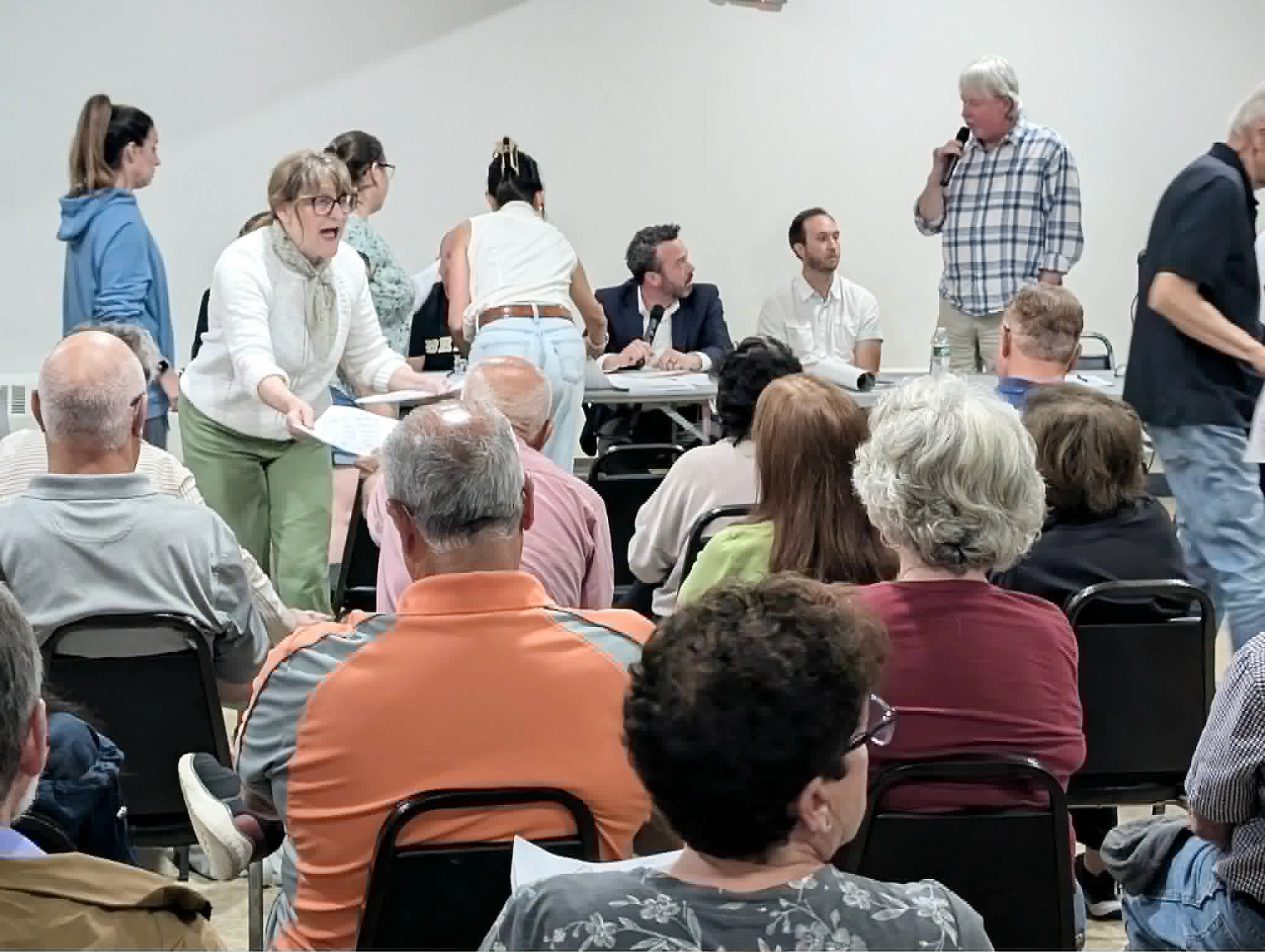
LINCOLN – More than 75 residents turned out Monday evening to the Knights of Columbus at 171 Jenckes Hill Road to oppose a 28-unit residential development on Wilbur Road, pledging to come back again during the coming formal review process.
They’re now raising funds to purchase yard signs signaling neighborhood opposition to the project, and several were suggesting possible legal action over this proposal as part of what they promise will be a prolonged fight.
Brad Clark, of 401HomeBuyers and owner of what is currently a single-family property on more than 4 acres at 92 Wilbur Road, and his attorney, Dylan Conley, tried to convince residents that these plans will be good for the neighborhood and good for the town’s affordable housing stock overall, but residents weren’t convinced.
Conley said these homes will be a similar concept to the well-respected Cottages on Greene in East Greenwich, a cottage court concept that’s caught on across the country but not as much in New England, he said.
Residents lobbed repeated accusations of greed, saying there would be no one in the room if Clark and his team were only trying to build the three or four single-family homes that would be standard for this rural property.
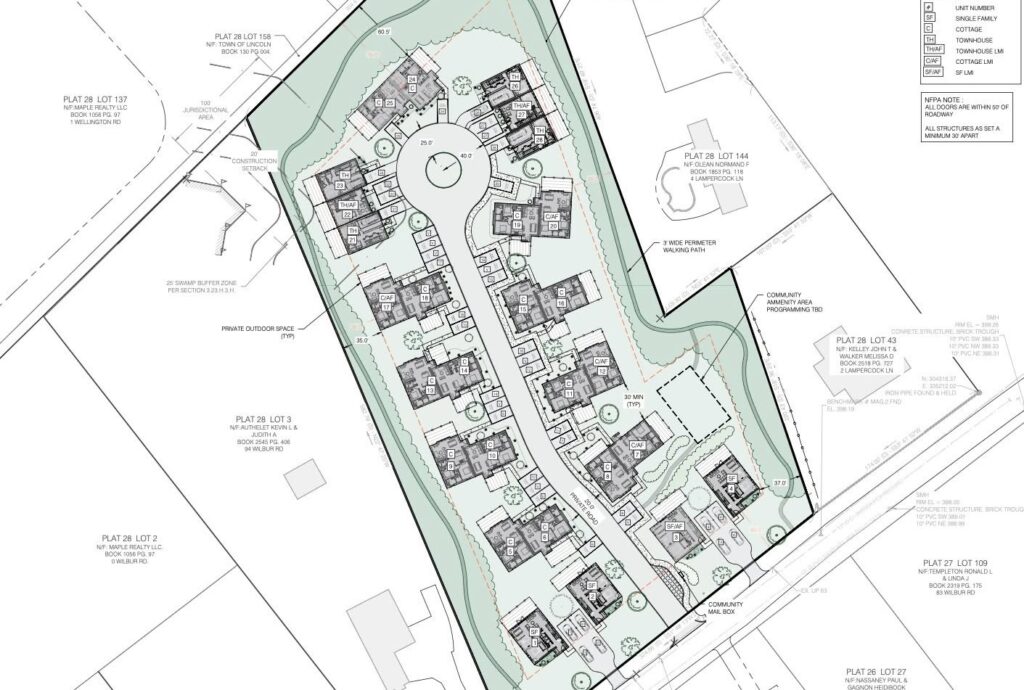
Conley responded that he attends many meetings for smaller proposals similar and repeatedly sees similar opposition. People understandably get upset about projects close to their homes, and how they might impact their lives, he said, which is why this developer is taking so many pains to make sure the project is a positive for Lincoln.
Residents made numerous comments about the affordable low-to-moderate-income (LMI) component of the project, but Realtor Deb Houghton, who helped organize the informational meeting, repeatedly said that this isn’t about LMI, but about the many expected impacts to safety, density, and water, among others.
The meeting grew contentious immediately. When Conley explained that 18 units will be fully accessible cottages in duplexes, residents responded that the additional emergency calls would mean an extra burden on fire and police services. Conley then commented that those in the room might have an objection to handicapped people living there, which drew shouts of anger from the crowd.
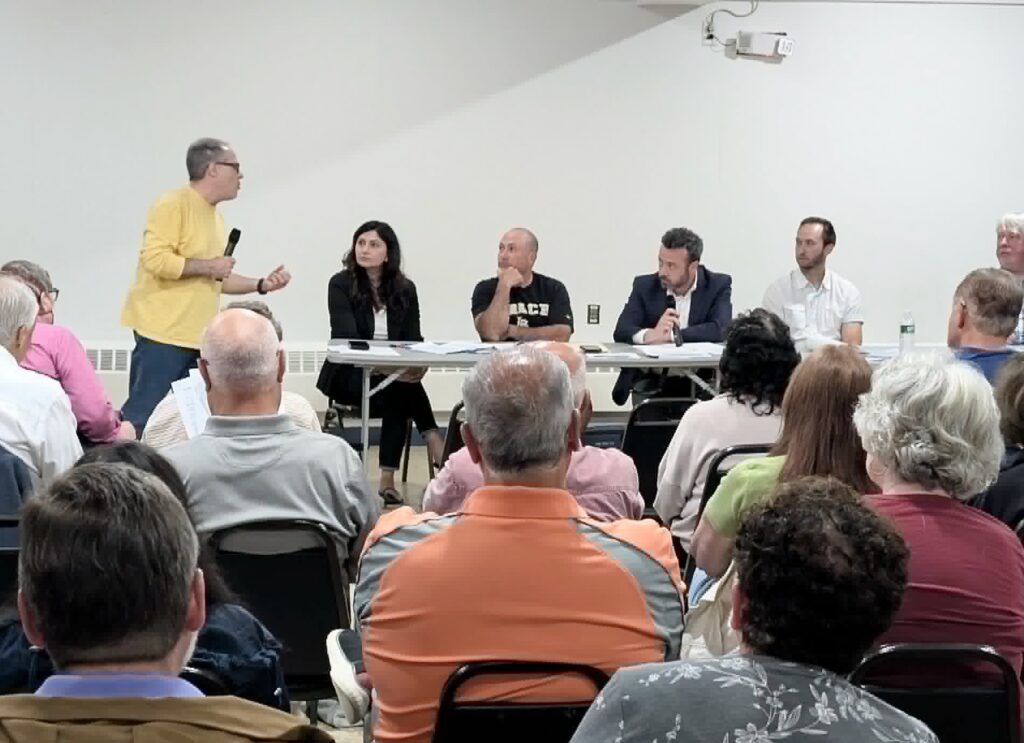
Similar angry comments were made when Conley started discussing the General Assembly’s push to ease the housing crisis through relaxed restrictions and asking questions about how many permits have been issued in Lincoln for similar accessible housing. He added that they’re going above and beyond state law for comprehensive permits.
Residents questioned the intent of homes being for those with disabilities.
“Do you really need a pickleball court for handicapped people?” shouted one man from the back of the room.
Conley said there will be extensive engineering between planning stages, and they’ll work out all details on slopes and other impacts related to accessibility.
The attorney explained that costs drive the need for more units. These are homes for purchase, he said, not rentals, explaining how he believes strongly in the idea of home ownership and developing new affordable homes to meet demand in Rhode Island.
When resident John Barr stated that his estimates suggest a profit of some $16 million for 28 homes, compared to less than $3 million for three or four homes, Clark disputing that, saying those numbers aren’t accurate.
When residents questioned why they weren’t given more information before any approvals, Conley said nothing has been approved at any level yet and the entire process is still ahead. He and Clark said that a lot of misinformation about the project started spreading because confidential conceptual discussions and sketches were leaked early. They said the application also won’t be ready for the July planning meeting, contrary to what’s been said.
Forum organizers weren’t able to get through their entire list of questions Monday, but co-organizer Andy Brown said they’re asking the developer to come up with concise written answers to all of them.
Conley explained that there are different standards for a town such as Lincoln that have not met the state’s 10 percent threshold for affordable housing.
Brown, who does not live on Wilbur Road, said his concern is that this project will set a precedent across town for other similar properties. He said residents need to defeat it to protect against neighborhoods being fundamentally changed and destroyed.
Asked if he’s driven down Wilbur Road recently, Conley said no. Residents said the narrow roadway is dangerous enough without adding more cars. Several spoke of moving to a rural area for peace, quiet, and safety for the rest of their lives, and how their hearts are breaking over a project that will take that way.
They warned that there are no guarantees that the homes will be filled with young first-time homebuyers or downsizing retirees, saying there are many people who want to be in Lincoln schools and they’ll be trying to come here with children.
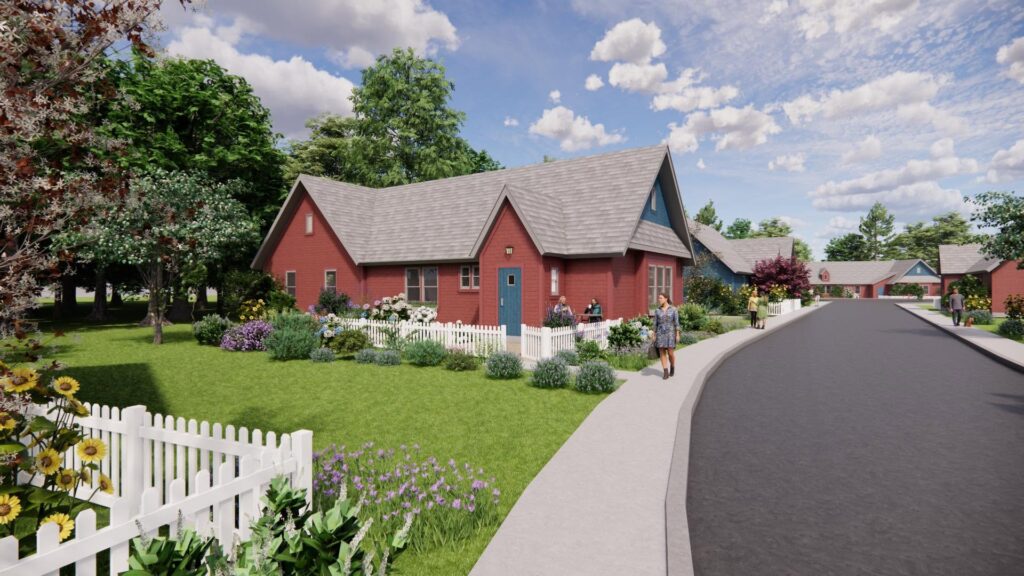
Conley said those aren’t the people these are being marketed to. He said the unit count is misleading, as the goal with more units was to take what would be very large buildings and shrink down the various components.
Abutters to the project peppered Clark and Conley with questions about how they’ll protect them from the project. They said it’s not enough to promise that the existing tree buffers will be maintained. They accused Clark of being in this solely for his own profit and not caring about them or Lincoln’s future. When Clark and Conley tried to discuss the extreme shortage of housing, there were sarcastic catcalls about the benevolence of Clark trying to be a hero and saving the town.
“You’re such a great guy,” called one resident, growing louder when Conley suggested that this project could lead to a petition to the state to help with traffic issues. “You are the traffic issue,” he called, later shouting, “go change the world somewhere else.”
Clark, in a post prior to the meeting, asked for friends and colleagues who live in Lincoln to provide feedback on what he’s trying to do.
“The concept is intended to provide much needed housing while being thoughtfully designed to fit the character of the neighborhood,”he said. “If you’re a Lincoln resident, or you support efforts to reduce the Rhode Island housing crisis, please comment below or send a private message. I would greatly value your input.”
Conley stated Monday that communities can block projects such as this when they meet affordable housing requirements or show that they’re constructing a lot of affordable projects or comprehensive permit projects, which Lincoln is not. He suggested that this project would make the town less vulnerable to projects being forced on it in the future.
Residents said seven units barely makes a difference for the town’s affordable housing goals. They also said that $378,000 for the affordable units isn’t very affordable, and if Clark really cared about making housing affordable, he would sell them for less. Clark later responded that he’s already taking a loss on those units.
Responding to residents asking why the whole town wasn’t notified by letter about this project, Houghton said opposition organizers took it upon themselves to write the letters that they did to Wilbur Road residents and residents of the roadway’s side streets.
Residents also asked what will happen to their property values.
There were a number of pleas for improved civility during Monday’s meeting, with some residents saying they should cut out the loud swearing and accusations during future meetings. Houghton said things got heated at times, but that’s what happens when people care deeply about where they live, where their children play, and what they’ve worked their whole lives to build. She said what matters most is that they stayed focused, asked the hard questions, and made their case with facts, with law, and with heart.
“That is exactly what this process requires,” she said.
Barr said his family has lived in town since the mid-1800s, and back when he was on the Zoning Board, this type of development was known as “cluster zoning.” He said they worked against it as hard as they could.
Developing ADA units isn’t a noble venture, he said, but about maximizing profits. Developers traditionally participate in a meeting such as this as a “soft sell,” he said, then when there are a lot of complaints, they knock down to a lower number that they planned on all along.
Barr warned of a “death spiral” on affordable housing, saying this project’s 21 market-rate homes will “kill us next year” and continue to drive a deficit.
He added that homes in the $400,000 range aren’t affordable, and he also doesn’t see a scenario where people spend $600,000 for a home in a 28-unit project.
If this development domino falls, said Barr, it’s going to have devastating consequences for Lincoln, and the town will start seeing these types of proposals everywhere. As a neutral observer who doesn’t have a dog on either side of this fight, added Barr, this opposition is the first line of defense, and if they stop it here, they’ll stop it for the whole town.
One resident asked if Clark is aware of the home values in the neighborhood, and when he said that he knows 72 Wilbur Road is for sale for $640,000, she responded that 72 Wilbur is not one of the nicer houses and this will have a negative effect on their property values. She said to be prepared for a class-action lawsuit.
“There’s a lot of money sitting in this room,” said another audience member.
Residents scoffed at Conley’s assertion that there are negative ways to fit 28 homes onto a property such as this, and there are ways to make it quality, “cozy,” and fit well, as they are doing. Residents suggested that Clark should try living in one of the units he’s trying to build.
Conley and Clark said the developer doesn’t just try to push through as much as he can, but they try to be conscientious about neighborhood impacts. All of the setbacks for homes are being fully honored with this plan, said Conley, and existing mature-growth trees are being maintained. Clark and his experts care deeply about getting it right, said the attorney, and is not pushing nearly to the extent that he’d be entitled to on this property.
Conley said he experiences intense opposition to projects with only three or four homes once or twice per quarter. People are attached to the beauty of their neighborhoods and where they grow up, he said, and the challenge comes in when more people want to live here and the number of homes stays static. Loved ones can’t afford to buy homes nearby and new people can’t move in, he said.
Conley said he appreciates that residents don’t believe this is the right spot for this project, but unfortunately he hears the same thing from people “at least a dozen times a week.”
Conley said early submissions are designed around what is conceptually manageable for a property, and once the process goes to the preliminary plan stage to see how it will work, plans can shrink, decrease in intensity, or simply not increase. It’s a “theoretical maximum” at the master plan stage, he said, and then the proposal goes through an intensive and increasingly detailed application and review process.
The attorney said there is no way, even if there wasn’t this level of intense scrutiny on the project, that they would be able to get anything pushed through that residents aren’t aware of.