



JOHNSTON – Many postcards show stunning vistas: trains gliding beside lakes and mountains, docks projecting into calm seas. Less common are postcards of ugly landfills and gas masks, a scratch-and-sniff surface giving way to the odor of trash.
These unsightly cards were the handiwork of Johnston’s first mayor, Ralph aRusso, who served the town from 1970 to 1994. Eccentric and resolute, aRusso had legally changed his name from “Russo” to appear at the top of the alphabetical ballot. Mayor aRusso remained crafty as he fought for more than a decade to close down the Central Landfill, which continues to be Rhode Island’s largest waste disposal site.
In the 1970s, Rhode Island officials had discovered that local companies were dumping millions of gallons of hazardous waste. The chemicals were leaching into the groundwater, flowing into nearby wells, brooks, and reservoirs. The extreme toxic pollution had earned the landfill classification as a federal Superfund site in 1984.
Mayor aRusso leveraged the EPA’s findings as he lobbied for the landfill’s closure. But in public, the battle played out as a family spat. The Central Landfill’s chief administrator was Mayor aRusso’s son.
The mayor was horrified by the postcards his son had distributed, which rendered the dump as a pretty landscape and advertised public tours. The mayor retaliated with his own postcards, along with t-shirts depicting birds over a mound of trash.
“Not until the state of Rhode Island started sending out lovely color postcards of 328-foot-high Central Landfill and offering public tours of the garbage mound did Mayor Ralph R. aRusso decide to put his foot down,” stated a New York Times article in 1989.
”It was just too much,” said Mayor aRusso, who had been seeking to get Central Landfill closed for almost 10 years, at the time. “Their postcard is an artist’s rendition of the landfill.”
Ultimately, Mayor aRusso prevailed. In 1989, Central Landfill was ordered to close within five years and pay millions to replace the polluted water lines.
But the Supreme Court later ruled that the company operating the landfill, now called the Rhode Island Resource Recovery Corporation, could build as many as three new landfills near the original mound. In return, Resource Recovery agreed to allow free tipping for Johnston and make significant payments to the town, which it continues to do.
Central Landfill still conducts the tours that Mayor aRusso once railed against. When Isaac Bearg visited, his guide shared what some might see as a disturbing fact: “I grew up in Rhode Island,” he said, “and my diapers are still in this landfill.”
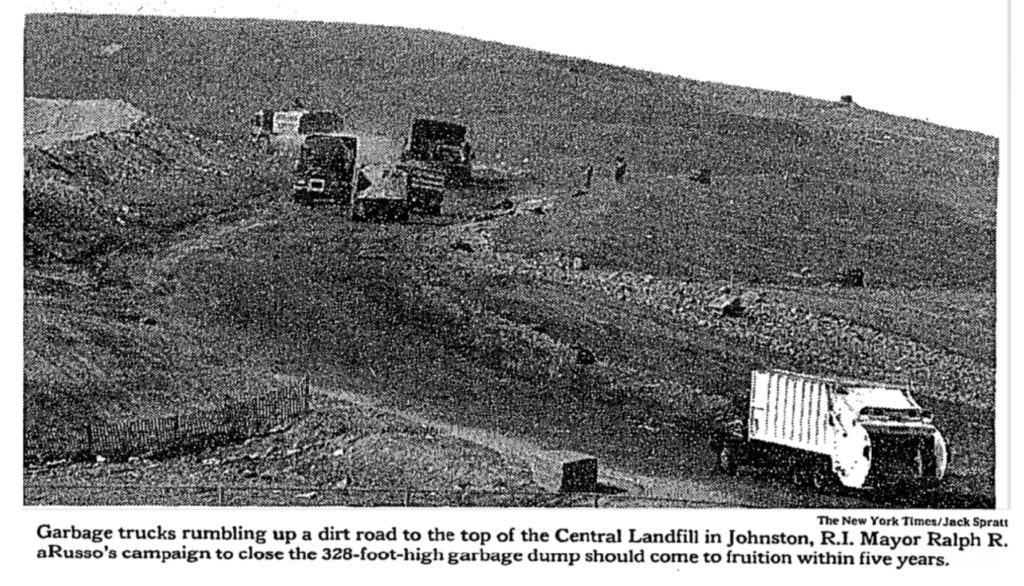
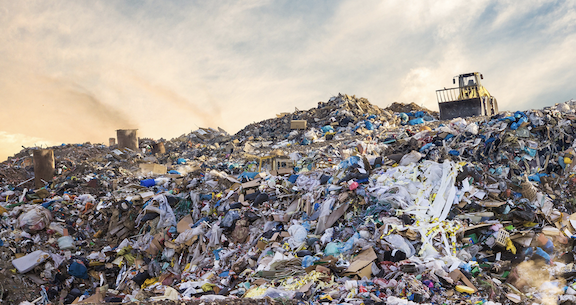
The second tallest mountain in the state, Central Landfill receives the vast majority of Rhode Island’s waste: 2,200 tons every day. At this rate, the company’s management warns that the landfill will reach capacity in 20 years, needing to shut its gates.
This time around, some Rhode Islanders have devised a weightier solution than postcard propaganda.
The Rhode Island Food Policy Council (RIFPC) recently launched the Food and Climate Action Partnership (FCAP), which aims to reduce food waste entering the landfill. The project targets five municipalities across the state, including Pawtucket and Central Falls.
The website for the Rhode Island Foundation-supported group tracks progress on diverting surplus and wasted food.
Bearg facilitates the project as RIFPC’s food, climate and environment program director. He emphasized that the project has benefits beyond extending the landfill’s life expectancy.
One concern is climate change. Of all landfilled material, food waste produces the most emissions of methane, a powerful greenhouse gas that causes global warming. Fortunately, when Resource Recovery settled a Clean Air Act case in 2002, they were required to install a modern system that captures many fugitive gases.
“Even if we take out the environmental impacts, there’s still a lot of reasons why we want to address the food system and how we’re managing it,” Bearg said.
According to the National Resources Defense Council, about one-third of all edible food nationwide is dumped into landfills. The waste is worth $414 billion per year, enough to feed every food-insecure American four times over.
Surprisingly, the biggest source of food waste is individual households, not commercial businesses. RIFPC specializes in convening and educating consumers about best practices, said Bearg. He named three main strategies: reduce, donate, and compost.
“A lot of reducing your wasted food is just being mindful of it,” he said.
Bearg recommends that consumers make a plan for how they’ll use the groceries they buy. The first things to spoil—fish, berries, and leafy greens, for example—should sit further up in the fridge, he suggested.
Bearg also advises people to consider donating unwanted food or listing it on Rhode Island’s “Buy Nothing Local” Facebook group, where users can scout free goods from their neighbors.
“Collectively, we are connecting person-to-person while keeping previously unmeasured tons of waste out of landfills,” wrote Liesl Clark, co-founder of the Buy Nothing Project. “The real magic of Buy Nothing … happens one person, and one act of generosity, at a time.”
For truly unusable food, RIFPC encourages people to compost in their own backyards. The best materials to compost are fruits and vegetables, coffee grounds and tea leaves, egg cartons, newspaper, flowers, wool, and egg shells.
Every March, RIFPC hosts a Compost Conference, where industry experts teach Rhode Islanders why and how to compost.
Several communities also have composting programs. Black Earth Compost, for instance, picks up scraps from homes in Johnston, Lincoln, and Pawtucket (among others) and drives them to compost facilities. In the spring, participants receive a bag of compost to nourish their home gardens. The rest is donated to local farms.
To address commercial food waste, RIFPC is partnering with the Center for EcoTechnology (CET) and FoodRecovery.org.
For free, CET works with local businesses to assess current waste levels and suggest improvements. If an organization chooses to move forward with a reduction plan, CET will offer training, resources, and technical support.
FoodRecovery.org connects businesses who have surplus food with local non-profits who need it.
“We’re really trying to lean into the three organizations’ strengths,” said Bearg.
FCAP was one of the first projects to receive a Catalyst Grant from the Rhode Island Foundation, amounting to almost $750,000.
“Catalyst grants support innovative initiatives focused on jumpstarting change and creating lasting progress,” wrote Chris Barnett, the foundation’s Senior Communications and Marketing Officer, in an email to The Local Insider. “RIFPC’s initiative promises to extend the life of the state’s only landfill, to feed hungry neighbors, to create compost for produce growers and to help five cities and towns reduce their waste management costs.”
So far, FCAP has engaged 130 businesses and recovered 9,500 pounds of surplus food.
“I don’t know if I’m going to be telling anybody to stop using diapers anytime soon,” said Bearg. “But all of the things that we can easily get out of the landfill, like food scraps, we really ought to be doing.”
Interested businesses can contact Bearg at . Follow along with FCAP’s progress at ri-fcap.org.