



LINCOLN – To meet future expected demand and ensure that water is getting everywhere it needs to in town, officials are considering a tie-in with the Pawtucket Water Supply Board.
At a joint meeting of the Town Council and the Water Commission on Tuesday, Aug. 4, officials and residents peppered Water Commissioner Chairperson Ken Booth with questions, particularly around taste, demand related to ongoing and future residential development, and capacity.
Booth explained that the current water system from the late 1950s, when Lincoln was a farming community, is insufficient, which is why they began analyzing options for buying water from elsewhere, including Pawtucket, Woonsocket, Providence, and Cumberland.
The decision was made in 1985 to connect to the Providence Water Supply Board, he said, and that supplies 5 million gallons of water per day.
The Water Commission is now recommending to develop a new connection with the Pawtucket Water Supply Board, along with a new Pawtucket pump station and storage tank with mixing capabilities at the Westwood tank. They’re also recommending installation of new Westwood and Old River tanks at adequate height and volume. Albion and Manville tanks currently provide adequate storage, but the Westwood one is too short and Old River is too small.
The existing connection with Providence Water would remain in place.
The total cost of the project, based on a preliminary opinion of project costs, would be between $12.5 million and $15 million, according an analysis from PARE Corp., and the project would take up to three years.
A source water assessment posted this week found current demand at 5 million gallons per day, but future projected demand between 8 and 12 million gallons per day.
Pawtucket was ranked above Providence Water and Woonsocket to develop another connection for 3 millions gallons per day more. The Providence option would bring 2 million gallons, and Woonsocket 1 million gallons.
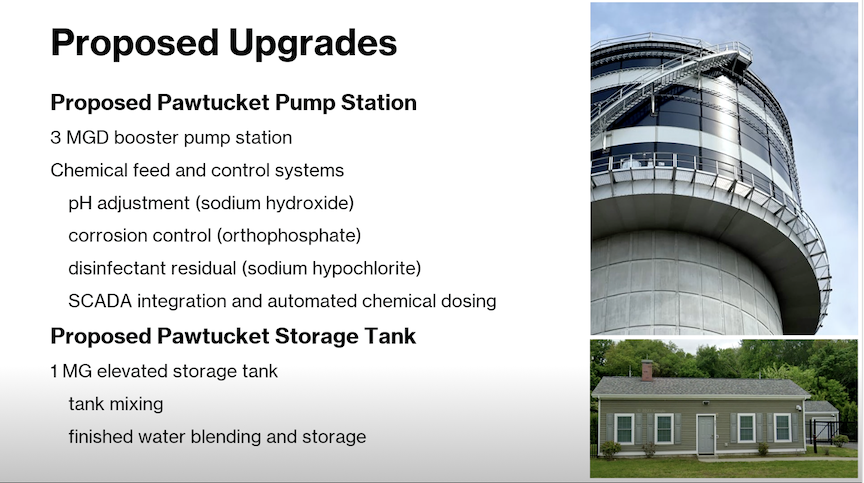
Booth said they assessed every option, including well options, and a Pawtucket connection was seen as best.
He said Providence pumps its water to North Providence, and then it comes to Lincoln from there, which means system is limited in what it can provide to Lincoln without limiting water pressure in North Providence.
The town is behind the 8-ball on this issue, said Booth, as the discussion started nine years ago with Providence Water but never came to fruition.
Councilor Bruce Ogni said one of the bigger issues he sees is overbuilding in town, saying he would favor a moratorium on construction. Booth said that while overbuilding has played a role over time in terms of getting water to certain areas, it’s really not why Lincoln is in this position. He added that there’s both a water availability matter and an issue with getting water from point A to B.

Ogni asked Solicitor Anthony DeSisto if a building moratorium might be feasible, and DeSisto responded that in order for such a move to be lawful, it needs to be based on studies indicating a problem, be for a limited duration, and has to be based on a municipality’s efforts to correct the problem. Showing that there are steps being taken to address the problem is necessary to be able to defend against the inevitable lawsuits, he said.
Ogni said he still thinks this is a route the town should look at, as more development is only going to add to the problem.
“I’m not a fan of any development, to be honest with you,’ he said, as he believes it’s changing the town terribly. Why, he asked, would the town keep letting people add to the problem.
Councilor Ken Pichette said his main concerns revolve around water quality, citing higher chlorine, lead, and other products contained in Pawtucket water according to reports. Booth responded that the reputation of Pawtucket water as a worse product is outdated, pointing to that system’s replaced water treatment plant and completely replaced and re-lined water lines bringing greatly enhanced water quality.
“It’s good water,” he said, later adding, “I don’t see that as a big red flag.”
Booth explained that lead comes about not from the source water, but from traveling through lead distribution lines. He also noted that the Rhode Island Department of Health wants Lincoln to actually boost its chlorine levels.
Ten years ago, the Pawtucket Water Supply Board received the Utility of the Year Award from the New England Water Works Association for its major upgrades.
Councilor Arthur Russo asked about mixing and whether the chlorine taste will be more noticeable in the Saylesville area. Booth said it’s a complicated topic, as it’s impossible to predict exactly where all the water would flow and be pulled, but yes, in theory the area closest to the mixing station would have the highest amount. He said he’s not sure anyone can model exactly where the water will be pulled from and how it will mix at this point.
Residents and councilors asked a number of questions about various options, including some suggesting the idea of ceding control of the system to Providence Water. Booth said his believe is that the municipality would want to maintain control of its own system. Ogni agreed, saying he would be petrified about “letting Providence politics determine our fate.”
Booth said a downside of joining Providence would be potential regular significant rate increases, with Lincoln only having one vote at the table.
Town Administrator Phil Gould said there’s a lot to consider with this issue. Lincoln has a great Water Department with fantastic workers, he said, but is currently without a water superintendent. He asked if this move would potentially jeopardize any future idea of outsourcing water operations similar to other services.
Booth responded that they’re in the process of seeking another qualified superintendent, saying he strongly believes in maintaining local control of water resources. Providence is always looking to make money, he said, not necessarily have Lincoln’s best interests at heart.
Gould asked if Pawtucket is only delivering 3 million gallons per day as a non-negotiable number, and Public Works Director Leslie Quish responded that they could potentially work with Pawtucket to release more water or go another route, such as buying from Woonsocket for additional capacity.
Ogni asked about potential grants for improvements, but Booth said that those aren’t generally available to a utility where there is a revenue stream. He said it wouldn’t really come to that unless a water system ended up as Flint, Michigan did.