



CUMBERLAND – A majority of school board members Thursday agreed with parents that the work done by the TransPar Group on redistricting has been subpar, at best, and that it’s time to go in a new direction.
As the meeting neared its conclusion, member Andrew Bacon asked that both an ending of the relationship with TransPar and nixing conversations on redistricting be placed on the school board’s next agenda.
Member Keri Smith, whose District 3 in the Bear Hill Road/Hines Road area would primarily be impacted by proposed changes with new options presented Thursday, said this area has been “chopped up, ignored,” and neighbors forced to look at those right next to them proposed to go to different schools than them for no logical reason.
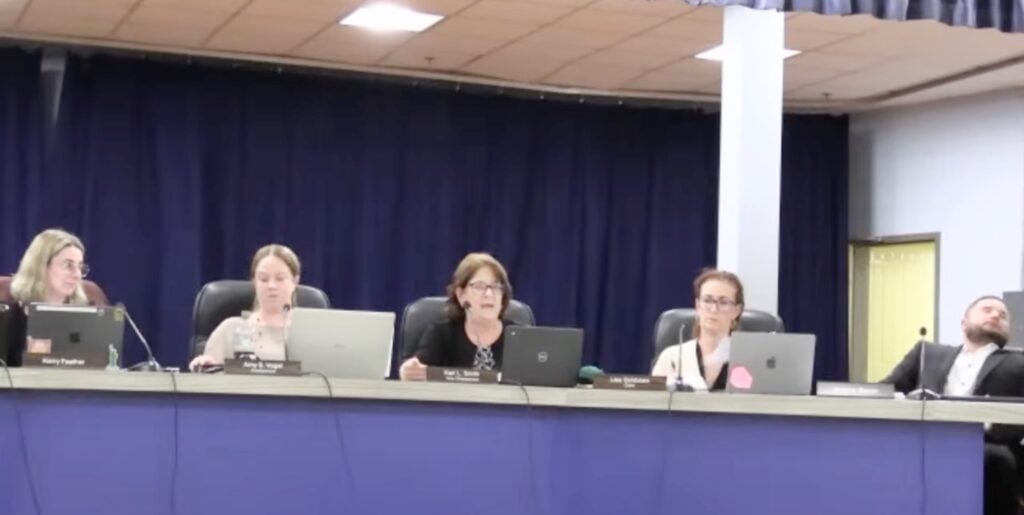
Four of seven members, Smith, Bacon, Jason Dean, and Kerry Feather, spoke out strongly against TransPar’s performance, making it likely that the vote at the next meeting would be successful.
Affected parents on Thursday questioned both the process and results of work done to this point, saying a second option on redistricting presented by TransPar didn’t even meet a basic standard for consideration. They urged school officials to stop thinking of this process as a map with circles on it, but to consider real impacts to families.
Further, they added, if the town has to redistrict again in another two or three years, as has been suggested, and with further housing developments near B.F. Norton Elementary School on the horizon, it doesn’t make sense to move a lot of students there now.
Dean questioned the formation of the stakeholder group to consider proposals, asking where he can get information on what that group discussed on constraints, tradeoffs, and community direction provided to TransPar as it initiated its analysis. Dean stated several times that he and Bacon are treated differently than others and their questions aren’t taken serious or responded to.
Chairperson Amy Vogel said multiple times that this is a process, and no decisions were being made that night. Responding to Dean, she stated that when she has questions, she sends them to central administration and then those are sent to TransPar, suggesting that Dean do the same.
Feather said the committee never saw multiple scenarios to consider as was promised, which helped to cause what she called the “great panic of August 2026,” as just one proposal was put on the table. She said she understands the resulting angst, and there absolutely need to be multiple solutions presented. The first solution was not tenable in any way, shape, or form, she said, and was actually nonsensical.
Smith said she was the one behind 12 questions posted about the process, saying committee members were repeatedly told that certain aspects of it were not within the purview of TransPar. If not the company, then who is responsible, she asked, noting that every redistricting process in the past has included those kinds of details.
Smith suggested that TransPar seemed more concerned with how to work a protractor or how to make a circle, and how to save money on buses, than actually doing the work of understanding neighborhoods and offering sensible recommendations.
Smith cited a number of “gaping holes” in the analysis, listing for an example 128 and 140 Hines Road, where families would be redistricted despite all promises of keeping everyone on roads together. Why not take other major roads, said Smith, and do the same thing of throwing everyone into one pile and saying this is what we’re going to do?
Supt. Phil Thornton said TransPar isn’t doing the routing of buses, but is creating zones.
Smith questioned specific housing developments’ placement, including Friars’ Green on Bear Hill Road being omitted on the elementary plan and the Preserve next door being included. She said her home across across from Friars’ Green was included in the move, and Millers Brook Drive was taken out while Sharon Drive and Katie Lane, which attach to Millers Brook, were kept. She said TransPar representatives could not possibly have driven the area and come up with these recommendations.
Smith, who also questioned driving times as presented, said committee members should have been presented with several options as was done during previous redistricting efforts when representatives from Durham School Services stood before them to answer questions.
Dean asked why there was only one scenario offered, and Thornton responded that the company was told to come up with its best mathematical concept for redistricting. Dean asked how TransPar could have considered transportation costs and other factors related to busing, and Thornton said the company still has a good idea of what routing looks like even if not responsible for coming up with bus routes.
Dean asked what factors were considered on Cumberland’s long-term growth related to moving students, and was told that was outside the scope of TransPar and would be more appropriately answered by town officials. Dean then responded that if the stakeholder group was charged with filling up a new school, B.F. Norton, it should have considered such factors as the coming Ann & Hope development and other housing projects coming.
Board members and the public laughed at Thornton’s assertion that he’s been told consistently that only around nine students are expected with the Ann & Hope development. Vogel said they can only go by the information they’re provided on what is known.
Feather than mentioned other developments where the number of children projected was far off from results. She said she’s not happy with what TransPar presented to them and doesn’t see any reason to continue with the company, which drew applause.
Feather said that though the previous redistricting process wasn’t fun, she liked having it done locally.
Bacon said redistricting should be a last resort, adding that the district should be looking at how to better use its existing facilities, including removing common spaces and turning them into classrooms. He said central administration could move to the old police station, or 8th-graders could be moved to the Transitional Building at Cumberland High School. Many things could be done to attack this problem without having to redistrict, he said.
Thornton said adults could be moved easily, but the situation becomes more challenging with students.
Feather asked why they couldn’t take 80 or so students from her neighborhood off Mendon Road to the new B.F. Norton, and Thornton said they would look into that idea.
Smith said it’s time to go back to square one on this whole effort, and this time involve the parents. Redistricting has to happen, she said, but this situation is just unacceptable. She said the only question she can think to ask is, “who did we piss off from District 3” to get such a bad dividing line through the district, with weird zig-zagging and such a poorly constructed plan. She said her primary concern is the students who would be impacted, including their mental health from having to be on the bus longer.
Smith said she agrees that the district needs to better utilize the buildings it has, as populations are going to continue to grow and she doesn’t see residents approving another bond. She suggested a tapered and staggered approach that understands neighborhoods and true needs.
When member Lisa Goldstein, who was on the stakeholder group, said some of what was presented also didn’t make sense to her, Smith said then it should never have been included in the plan.
Goldstein, who said she’d suggested a modified middle school schedule, said she didn’t have a model she was looking a that was a great one, saying she brought some concerns about fairness to Thornton. She said this isn’t perfect, but the committee decided as a whole not to pay to have TransPar come, which is why she and Mark Fiorillo were left presenting specifics. She also indicated money was a consideration, as they were going to potentially be charged more money by TransPar for major tweaks.
Vogel cautioned that there are many factors to consider in this process, including population growth’s impact on certain classrooms and the teachers and students in them. The district can’t be having one classroom with nearly 30 students and one with fewer than 20, she said, and they also need to follow the collective bargaining agreement with teachers.
This is not the only solution, said Vogel, and there is plenty of time before next February to get it right.
Parent Lisa O’Connell, of 140 Hines Road, said the Option B map presented that evening left her frustrated, angry, and hurt. She said TransPar was presented with rules, such as not separating people on any street, but broke them.
“Maybe you shouldn’t have to be charged for that,” she said.
O’Connell added that Option B only addresses Garvin Elementary School, pulling just three families from her street to B.F. Norton Elementary School. Everyone else stays together, said, with no logical boundary to be found. A look at actual geography raises more questions than answers, said O’Connell, uprooting families for no apparent reason. She said she has little faith in in the work of TransPar, urging officials to stop looking at numbers on a spreadsheet.
These are families who built their lives around a certain school and choose schools for a reason, she said, and they may have to be uprooted based on a pattern that makes no logical sense. She urged officials to reconsider current scenarios, consider moving neighborhoods closer to B.F. Norton School first, and to exclude families on Hines Road.
Kristine Brown-Donovan, a longtime teacher in the district, rebuked those in the room for their disrespectful behavior toward others, saying she would never allow it in her classroom. It takes courage to stand up and speak up, she said, but it also takes courage to sit down and listen while someone else is talking.
Redistricting needs to happen, said Brown-Donovan. Public schools means they’re shared by the community, she said, and all of Cumberland schools share common threads and all have some of the best educators in the district.
The reality of public education, she added, is that people don’t necessarily get their school of choice. She spoke of her school, North Cumberland Middle School, being overpopulated, asking those in attendance if they would rather have 22 students in their child’s classroom or 29 students.
The bottom line is that Cumberland is one community where students all end up at the same high school, and there’s long been an underlying idea that one middle school is superior to the other, said Brown-Donovan, but that’s not true. She urged the committee to “even out the playing field.”
Nichole Donaldson, of 9 Cargill Road, said where her children go to school isn’t something she cares about, she cares about them not being dragged from one school to another. Every school in Cumberland is fantastic, she said, but what’s happening through this process is not OK. She described a situation where her twins will be moved to their second new school in four years, and their commute to school will be doubled to 20 minutes. She said her rising 7th-grader will be moved again for the second time in four years, urging the committee to align redistricting around geographical proximity, maintain middle school continuity, and to implement grandfathering with transportation.
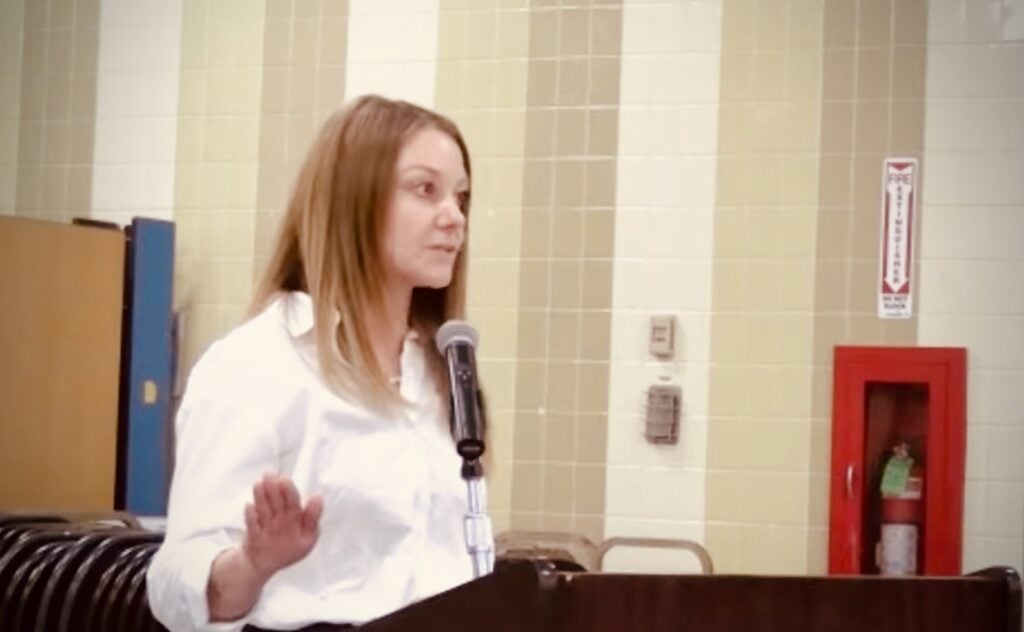
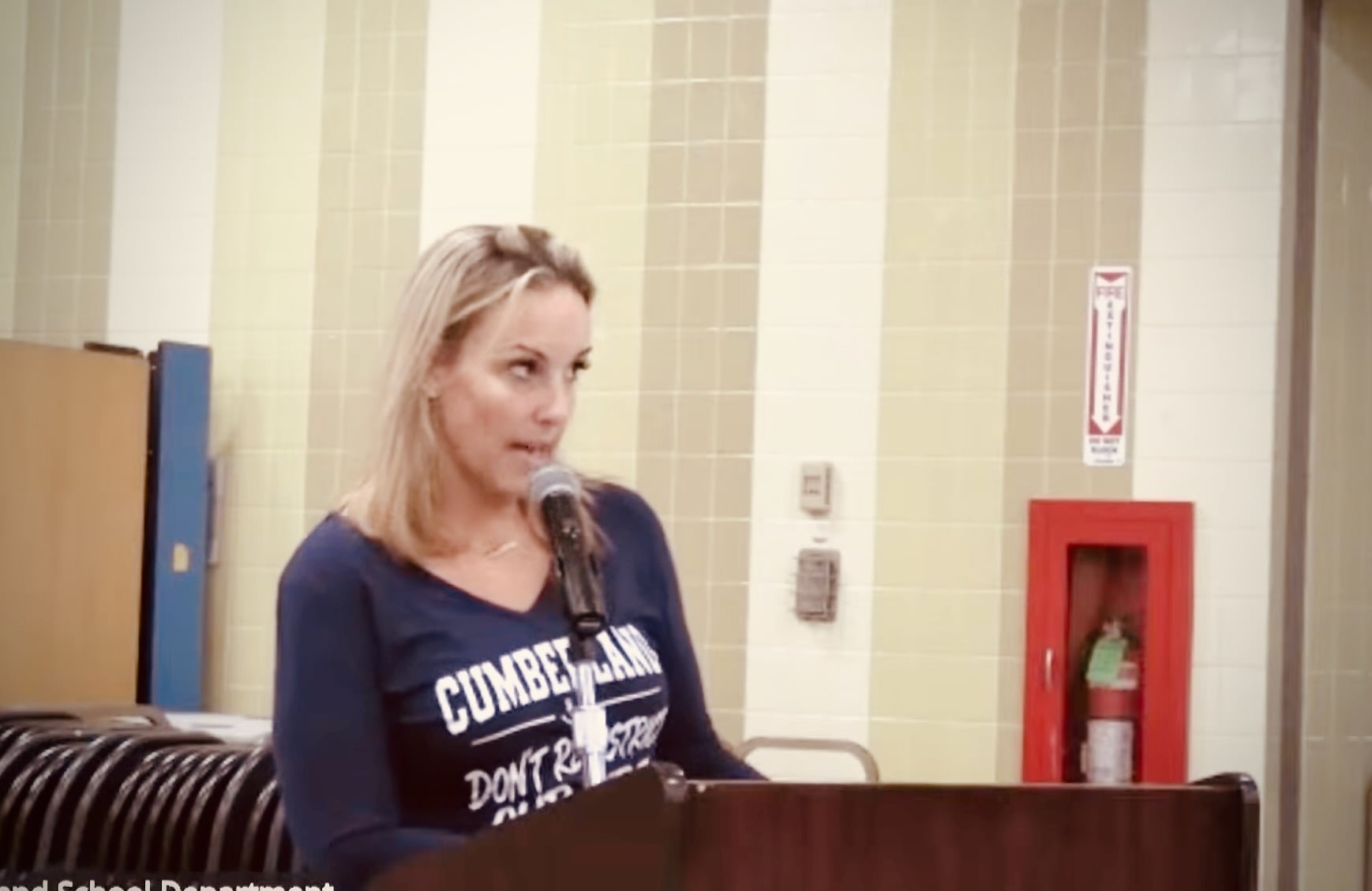
Tom Myers, a parent from 11 Cargill Road, wearing a “don’t redistrict our kids” shirt, said this process has brought nothing but uncertainty and division. He thanked everyone for being engaged and passionate in the interest of their children and advocacy for fair and logical solutions. Stability matters, he said, and their children have faced enough disruption already. This isn’t a north/south debate, he said, urging officials to go with a third option of keeping current district lines and monitoring actual enrollment. Why solve something that may be solved tomorrow, he said, with the arrival of children in pending developments of southern Cumberland, while keeping everyone aligned with their nearest schools.
“Redistricting should be a last resort, not a first response,” he said.
Ashley Tamke, of 8 Cargill Road, said she too is deeply concerned about the process and how everything got to this point. Conversations should have happened with parents before any initial options were released, she said, and parents have been left frustrated at being left out.
Tamke said her neighborhood is disproportionately affected. She added that her children would be going to the third furthest elementary school from their home in a town with five elementary schools, and she struggles to understand how that makes sense.
She called for a “more geographically responsible” solution, one that is thoughtful and sustainable. This proposal makes the Bear Hill/Hines Roads essentially a “peninsula” used to fill spots while disproportionately impacting families, said Tamke.
“We deserve better,” she said.
Samantha Barkley, of 9 Blacksmith Road, said this was a rushed process that hasn’t delivered on promises, and wasn’t thoughtful in any way. TransPar agreed to do surveys, host forums, and conduct structured outreach through multiple opportunities before any plan was presented, said Barkley, and none of that happened. The district was still trying to figure out school start times while asking the community to accept boundary changes, said Barkley.
Barkley questioned TransPar declaring that the local business system was running fairly efficiently, then giving it an F-grade for both morning and afternoon. She said the district is moving toward isolating its own standards on times, and parents deserve straight answers.
David Rodoni, of 5 Blackberry Bluff, called the initial findings presented by TransPar “ridiculous.” He said it feels unserious, spiteful, condescending, and not well thought out, telling the committee to reject payment on the work.
It’s in no one’s best interest to fill B.F. Norton Elementary School to the brim, said Rodoni, though he understands filling it slightly to reduce the load, which is something of what option B was trying to do.
Rodoni said he came from California, where portables were used when classes became too packed. He cited a computer class he had to go outside for.
He urged local officials to consider secondary options, saying the town needs “a different paradigm” and different choices, including an option he saw for possibly separating middle school by grade.
Cumberland needs a different way of thinking that could solve these issues, he said, and TransPar is not doing that. Cumberland needs to be more proactive in the way that it thinks about fairness, said Rodoni.
Several more parents also testified on their concerns.
Smith echoed the crowd, saying school officials need to “stop the bleeding” and end its relationship with TransPar.
Feather said she doesn’t think using an outside company makes sense, saying the district should look at achieving local community-centered consensus that still meets the guidelines of the Family Educational Rights and Privacy Act.
Bacon said he doesn’t want to keep having these contentious discussions until February. He suggested that since committee members represent all five districts in town, they can meet with and get input from residents on their own, similar to their successful PTO meeting, come up with a plan, and speak for everyone.
“That’s what we were hired to do,” he said, to applause.
He then requested that the next agenda feature the votes to end the redistricting conversation and vote to end all contracts with TransPar. Dean attempted to second the motion on both items, but Vogel responded that the matter wasn’t on the agenda, so there was no vote to be taken. Dean started to protest and find written rules allowing him to make the motion, to which Vogel responded with some sarcasm, “look it up and let us know.” Bacon then told Dean that they were all set with the next agenda simply with his request, and they didn’t need a vote.
Before adjournment, the committee voted unanimously to reject a quote for an additional on-site visit and virtual meeting with the TransPar Group, which had been tabled from Sept. 10.