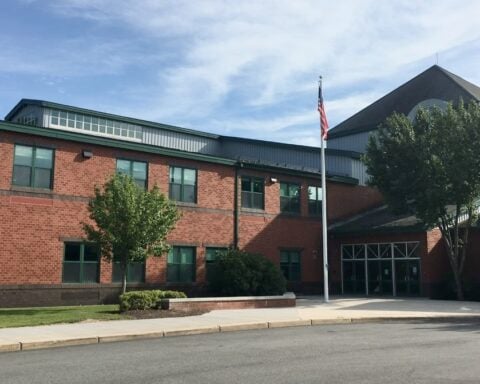



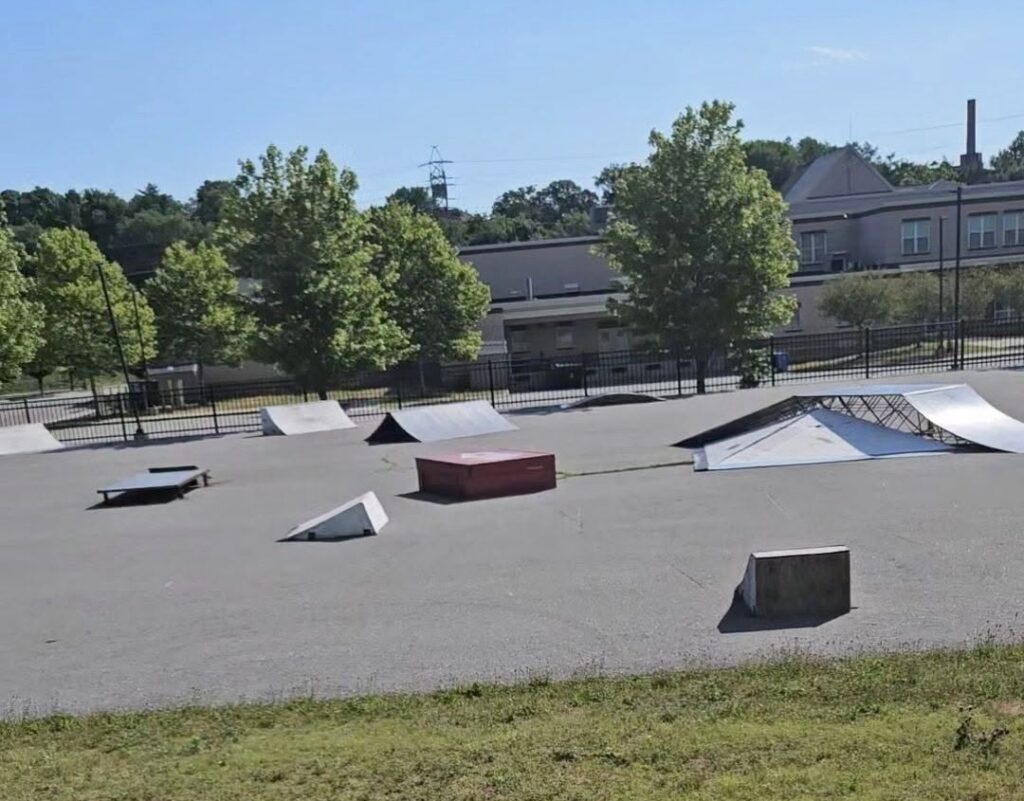
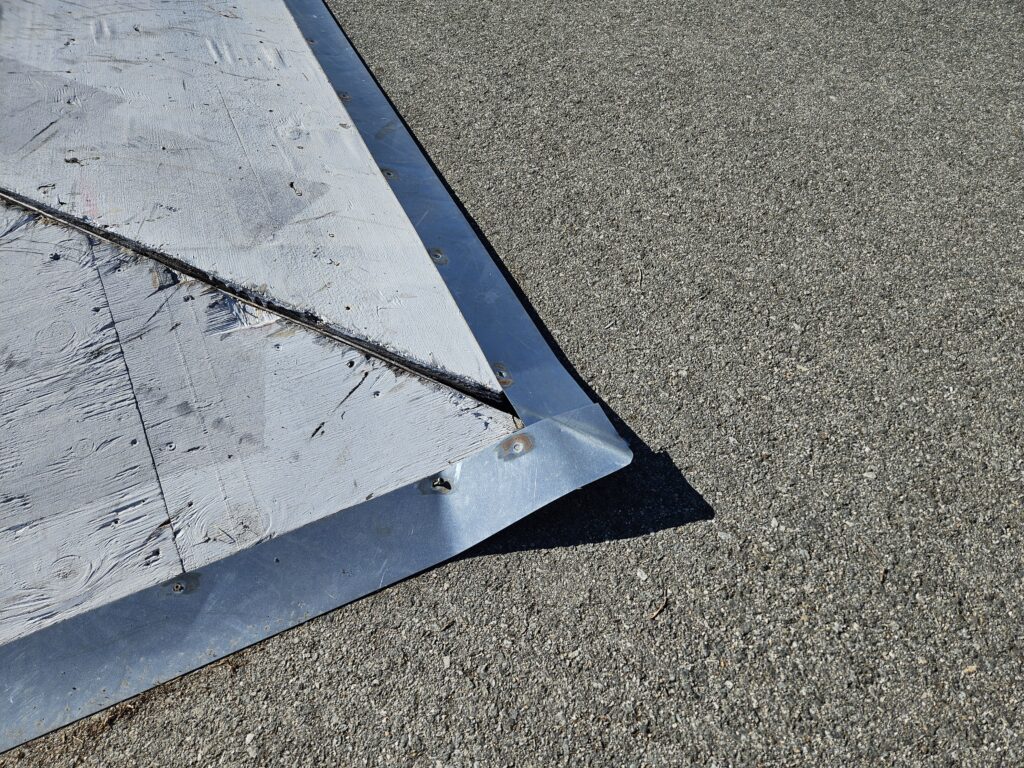
WOONSOCKET – Tucked behind Hamlet Middle School sits a concrete lot with a few scattered ramps, their wood rotting and metal supports bent or missing.
The Woonsocket Skate Park is a far cry from the modern skateparks in other parts of Rhode Island, where smooth concrete obstacles flow from one to the next. The park’s condition has motivated a local skater to launch the Woonsocket Skatepark Revitalization Project (WSRP), a local movement calling for a full-scale skatepark renovation.
Raymond Huot, who started the WSRP as a petition three weeks ago, is a city resident and regular skateboarder at the park. He says he moved here more than a decade ago and recently learned that the skatepark on Hamlet Avenue used to be located at the high school grounds/Cass Park in the 1980s-1990s, and eventually moved to Hamlet Avenue, where it is “in a sad state.”
“I go there on a Sunday morning with my coffee and my Bluetooth speaker and just kind of do my thing, and I wind up being there alone most of the time,” he said. “So it’s part of what the WSRP is trying to change, (it’s) trying to make that park more of a place to go for everybody.”
As Huot has noticed signs of disrepair, he has become increasingly concerned about skaters’ safety.
“I’ve been trying to teach my daughter to skate a little bit, but for the most part, a lot of the ramps are in really bad condition, and when somebody who doesn’t really have a whole lot of coordination yet is still learning, they could really seriously hurt themselves on it,” he said. Huot has seen a child trip on a ramp and hurt his chin, a minor injury, he said, but an incident that could deter a kid from continuing to skate.
Skatepark activism has a recent long history in Woonsocket. In 2011, Woonsocket had no skatepark, and a group of skaters and parents expressed frustration that the city had destroyed an area of the World War II Memorial Park where people practiced the sport.
“If they’re improving the park, that’s great, but all they did was destroy the tennis courts, it seems like just to stop us from skating,” then-17-year-old Luke Winn said at the time.
Michelle Boyce, the parent of a local skater, started a previous petition that garnered around 100 signatures. Boyce emphasized the need for a curfew and locked gate to prevent vandalism, which had destroyed two prior skateparks in the city.
In the years that followed, Susan Kirwan, the owner of a since-closed local skate shop, attended council meetings to advocate for the development of a skatepark. When the city finally approved one in 2016, members of the skating community expected a built-in concrete course. But after waiting for nearly a year, many were disappointed to find just a smattering of donated obstacles.
“I wanted to show these kids that you could build something from nothing,” Kirwan said in 2018. “Now, I feel like I’ve been made into a political pawn over here and I’m kind of upset.”
Kirwan continued pushing for additional funding for the park with little success.
More than 300 people have signed Huot’s petition, which highlights how a modern skatepark would promote healthy lifestyles for Woonsocket youth and boost local commerce by offering a space for events.
According to Huot, an improved skatepark would also support “alternative cultures … that just aren’t really supported anywhere here,” he said. He envisions the park as a space where local bands and artists can display their work.
A national survey by the University of Southern California found that skateparks offer extensive mental health and personal development benefits. Respondents described skateparks as welcoming places where they could feel safe and accepted, form cross-cultural relationships, and practice managing serious emotions.
One respondent, a 19-year-old skater from New York, said, “The group of us skateboarding, we were diverse culture-wise, Italian, Spanish, black, white, me, I’m Pakistani and British, all types. We were all diverse, it didn’t even matter, none of that mattered. We just spoke the same language of street brothers. It was more of this bond we developed from each other’s pain. It was kind of very deep in a way.”
Many skaters said they think of their skatepark friends as family. Others reported that the life skills they learned at the park, from social interaction to persistence in the face of a challenge, improved their job prospects.
A 13-year-old skater from California said skateboarding “brought this like confidence out of me … And now I know it would help me in other topics, like on my job … I was young, but I knew if I kept pushing, they would give me the job, and that’s what I did … I’m not scared of taking risks anymore, because once you’re in skateboarding, (laughs) you take big risks, and you take big hits and falls, but that actually builds you stronger.”
Since Huot started the petition in Woonsocket, he has received support from hundreds of community members. One Facebook user challenged the city’s unwillingness to renovate the skatepark despite spending $8 million on a new football complex, which opened at Cass Park last fall.
Mayor Christopher Beauchamp publicly commented on the petition.
“I would love to upgrade the skate park, my son is a skateboarder, but we would have to secure a grant to accomplish the upgrade,” said Beauchamp.
Huot says he is beginning to explore potential grant opportunities through foundations such as The Skatepark Project, formerly the Tony Hawk Foundation.
“When I first started (the petition), it was just a dream,” said Huot. “Now, the little bit of stir has been started, too.”
The petition remains open for signatures at change.org.