



By Rob Smith / ecoRI News staff
Note: This story was reported by ecorinews.org. It is published with permission.
JOHNSTON, R.I. — Undeterred by recent opposition, the Woonasquatucket River Watershed Council is determined to show local residents the benefits that come with restoring the river and expanding a segment of the long-standing Greenway Bike Path project.
Since 1993, WRWC has been focused on restoring the Woonasquatucket River, cleaning up its polluted segments, and creating a public space that restores and protects vital habitats and provides outdoor recreation.
The nonprofit’s River Rangers team has removed much of the invasive plants, such as mugwort and knotweed, from an area around the Greenway near Goldsmith Street, and on Sept. 26 they are inviting the public to get involved, plant native vegetation, and learn more about the bike path.
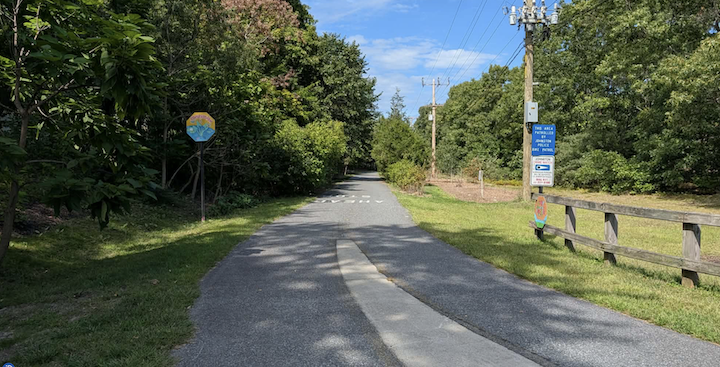
WRWC director of projects, Lisa Aurecchia, met with ecoRI News last week for a brief walking tour of a segment of the Greenway between Greenville Avenue and Goldsmith Street.
The project has included more than just paving a bike path, said Aurecchia, pointing toward public murals, rain gardens, and a fish ladder for river herring to cross over the Manton Dam.
“This whole area of the river used to be filled with fallen trees,” she said. “It was used as a dumping ground.”

The Greenway Bike Path currently crosses the river in Providence, before entering Johnston from the south. Its southern extension ends not far from the town line at Lyman Avenue.
A future one-mile expansion north further into Johnston is designed to take the bike path as far as Cricket Field (on the North Providence line), according to Aurrechia, but the WRWC has run into a stumbling block: the town of Johnston itself.
Last month, prodded by a group of potential abutters to the future expansion of the path, the Town Council voted, 4-0 with one abstention, on a resolution opposing any extension of the bike path.
The Johnston Sunrise reported Aug. 13 that some residents expressed concern over potential crime, saying it wasn’t a good idea for the neighborhood, and that the resolution was backed by Town Council President Robert Russo.
“We want to make it clear that we don’t want any passageway through the town,” said Russo, as reported in the Johnston Sunrise.
Russo did not return ecoRI News’ request for an interview.
The plan for the Woonsquatucket River Greenway has been more than 33 years in the making. The WRWC was formed in 1993 originally as a nonprofit dedicated to bring the Greenway to the Olyneyville section of Providence.
For much of Rhode Island’s history, rivers like the Woonsquatucket were either industrial assets or dumping grounds. Rarely were they prized as environmental assets, with Providence famously building over its rivers and covering them up for much of the 20th century.
To the WRWC, said Aurecchia, the Greenway is more than just a bike path. The project’s goal is to improve the health of the Woonsquatucket River and bring wildlife back to the river’s urban areas.
It’s also practical; as the state believes the impacts of worsening storms and increased rainwater caused by climate change, rivers like the Woonsquatucket can get overwhelmed quickly without proper restoration, becoming a flooding hazard to roads and other infrastructure.
Much of what the WRWC has planned for the Greenville Avenue area next to the Greenway revolves around installing proper drainage for stormwater, such as swales, and guiding the runoff away from impervious surfaces where it can pick up pollutants that get carried into the river.
The WRWC has been trying since 2015 to expand the Greenway north, but has run into obstructions over the past 10 years as some residents organize against the bike path. Aurecchia said the watershed council gathered 700 signatures in support of the project from local residents a decade ago, and aims to repeat it if required.
The goal now, she said, is to show skeptics what the Greenway can do for the environment. WRWC’s planting event, scheduled for Sept. 26 from 10 a.m. to 2 p.m. at 15 Goldsmith St., is meant to help people understand the benefits brought by the project.
“It’s not just a bike path, it’s a valuable resource for the public,” Aurecchia said. “I’ve had people come up to me who opposed this part of the path say it’s the best thing to happen to this neighborhood in a long time.”