


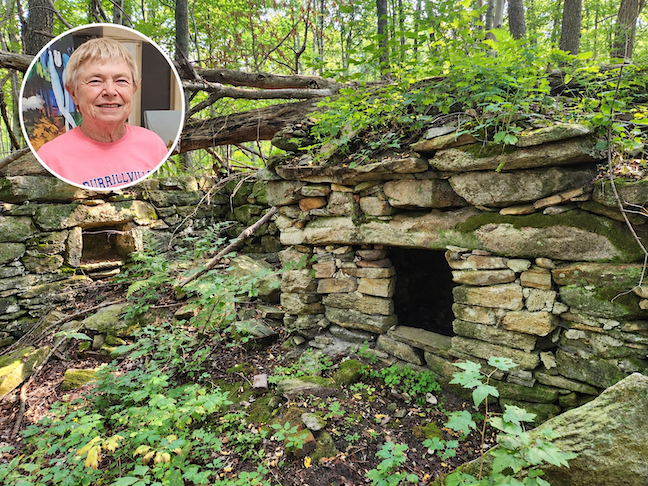
BURRILLVILLE – When Betty Mencucci, president of the Burrillville Historical and Preservation Society and member of the Rhode Island Historical Cemetery Commission, first learned about features of a property within the town’s industrial park off Broncos Highway in January of last year, she says she was immediately intrigued.
Mencucci went before the Town Council on Oct. 14 to, as she explained it, try to make them understand the significance of an old foundation on the property, one she says has unique features unseen elsewhere. She said it possibly dates back to around the time of the Revolutionary War and features evidence of a cold cellar and two niches in the wall.
The discussion turned contentious after Betty and her husband, Carlo, suggested that town officials weren’t taking the matter seriously.
She said a study done by the Public Archaeology Laboratory, of Pawtucket, focused on piles of stone on the property rather than the foundation she was interested in, predictably finding little significance to the stones left by farmers clearing their fields. She said officials then accused her of wasting money pushing for the study in the first place.
Officials, including Town Manager Michael Wood and Director of Planning and Economic Development Raymond Goff, responded that Mencucci should have involved them from the beginning rather than going around them. They said they’re doing nothing outside of normal processes as done with any property sale or development project.
Mencucci posted prior to the Oct. 14 meeting that the town is trying to sell the property for industrial purposes, and when it’s sold, she doesn’t know what will happen to the foundation.
“Once it’s destroyed, you can never get it back,” she said, suggesting that it should be studied and preserved for future generations.
The foundation is located near wetlands and it was suggested by the state archeologist to include this foundation with the wetlands and not to disturb it, said Mencucci.
After being told by someone about upright stones as possible gravestones and the foundation and possible corn crib supports on site, Mencucci said she reached out to the state archeologist. The town then hired Crossman Engineering to engage in a contract with the Public Archaeology Lab, she said, and they ended up spending $14,450 just to study the extensive stone mounds. The finding of metal in those piles showed that they were created by farmers and not Native Americans, she said.
Mencucci she was concerned about the unique foundation and uprights for a corn crib, and never mentioned stone piles, yet said that’s what the town decided to spend the money on to determine that this was nothing more than an old agricultural site. Mencucci asked who decided to spend the money on the piles and not the foundation, because she got blamed for wasting the town’s money even though she never asked for that.
Mencucci said she’s been told the foundation is not under threat, but if that’s the case, they should carve out this historic area before any sale to be able to control what happens with it.
Mencucci said she was overwhelmed with positive responses when posting about the foundation, and the town should be embracing this site as a positive instead of a nuisance.
Wood responded that Mencucci was not bringing her concerns to the right venue, and should instead address them to the Planning Board, which reviews plans and decides what can be developed and where.
When Mencucci responded that it could be too late if the property is sold already, Wood responded that the board could decide on a property carve-out at any point in the process. He said the town is in the process of looking for someone to buy the property’s three subdivided lots, including the one with the foundation on it.
The town won a significant grant to pre-plan and prepare the lots for sale, said Wood, and with that work came a letter from state preservationists saying that the property has no history-related issues.
The planning staff was doing what they needed to do to get the property prepared based on that finding, he added, when Mencucci decided to go on the property and report her suspicions to the state without talking to them first. He stated that Mencucci has always had her own agenda and has never worked with him on anything.
When audience members reacted in anger at Wood’s response, he replied to them that it’s the truth. Council President Donald Fox then called for decorum.
Wood reiterated that the council isn’t empowered to decide what happens with the property, and if there are historical issues, the Planning Board will take those up when the time comes for development.
“That’s how it works,” he said.
Wood added that he’s aware Mencucci believes there’s an existing plan for development that cuts the foundation in half. He said there was such a plan, but another was also created that carves that particular parcel of land out. Mencucci, he said, simply doesn’t ask the questions, doing her own thing on her own time, including reporting her concerns to the state, when all of this could have been avoided by talking to them.
When Mencucci responded that someone told her of a possible gravestone and that’s why she went to investigate and then asked the state archeologist about it, Wood asked her if she knows where the Planning Department is. Mencucci then responded that she’s not going to ask town officials about such a matter, because they’re not the professionals in that arena.
Wood said Mencucci forced them to spend a lot of money they shouldn’t have had to. Mencucci said they wouldn’t have even known about any ties to history if she hadn’t done what she did.
Goff said the town has owned the property since 2000, and it’s been zoned industrial since 2006. He then noted that they had a letter saying nothing historical is contained on the property, prompting Mencucci to respond that the letter writer was wrong.
Goff said he would love to know who told Mencucci that there was something for her to look for on the property. He said he could tell Mencucci was hoping the property was a cemetery, suggesting that perhaps she was blinded by hope.
Because of Mencucci, he said, they were forced to investigate more of the property than they should have had to. He said Public Archaeology Lab representatives didn’t find the foundation all that unique. He added that half of the foundation is still in the wetland, and it could be decided that the entirety of it is just carved out from the property.
The plan Mencucci saw was a concept, not an actual concrete proposal, Goff said, and nothing is carved in stone. Mencucci, he said, then took that idea and ran with it, telling people that the town was going to bulldoze it and destroy history along the way. Wood said no one is anywhere near bulldozing anything.
Goff said he thinks at a minimum, someone should issue a notification if they’re planning to enter a property. When Mencucci then responded that it’s a town property, he responded yes, but there’s a town administration that actually knows what’s happening with the property and it makes no sense to go ask someone else about it.
Wood said they would have done what they needed to, and they handle these types of issues all the time.