



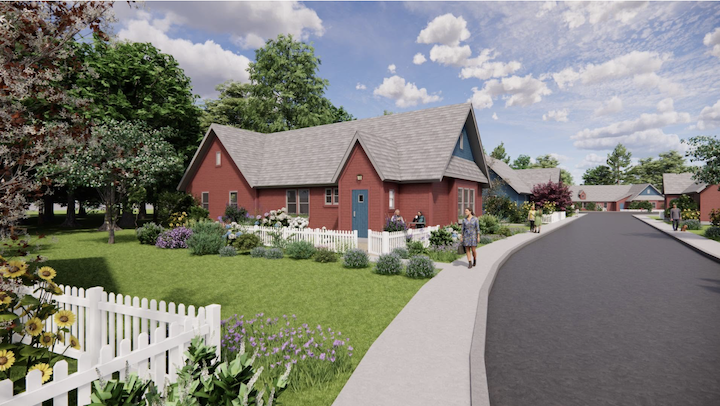
LINCOLN – After a discussion seemingly focused more on setting up a court challenge than coming to a compromise, the Lincoln Planning Board has rejected a conceptual master plan from 401 Homebuyers LLC to develop 28 new units at 92 Wilbur Road.
The room was again full as residents turned out to voice their displeasure with the development proposed for a rural agricultural zone full of large single-family land parcels.
The vote to reject the plan for what is now being called the Cottages at Powder Hill was unanimous, and came after board members on Nov. 18 repeatedly asked for further detail on a range of items for the comprehensive permit project, including water, infrastructure, and safety concerns.
Dylan Conley, attorney for the developer, repeatedly stated the developer’s intention to pursue the project as permitted under the law, and again and again said that more details will be provided at the preliminary plan stage. He said legal and case law precedent give boards the role of identifying potential issues rather than resolving them at the conceptual plan stage.
Board members, clearly growing frustrated at Conley’s lack of willingness to engage on the finer details, said at the end that they wouldn’t even know what they were voting yes on if it came to that, as the application had become a confusing mash-up of this project and a previous iteration, with no real details.
They also weren’t buying the developer’s stance that the need for more affordable housing in town outweighs local concerns. Member Tom Tuytschaevers said seven affordable units, or 25 percent, is a drop in the bucket and doesn’t hold a lot of weight with him. He noted that he’s never seen opposition turnout quite like this for a project, and he continues to be concerned about road width and contamination from an adjoining property. Local concerns do outweigh the need for affordable housing as presented here, he emphasized.
Member Michael Reilly said he would expect more than 50 percent affordable units for a project seeking this type of density bonus, saying the developer was being excessive in his demands.
As a smaller issue related to all the other concerns, Chairperson Ken Bostic asked why the developer proposed bituminous berms instead of granite curbing for the project. Conley said that hadn’t been mentioned before now, to which Bostic asked if he’d like to take a few months to look at it and fix it.
“No thanks, Mr. Chairman,” Conley replied.
Conley’s comments drew frequent derision from the crowd, including his statements about the town’s affordable housing plan being drafted after their plan submission. He said the plan can’t be used to deny their plan, but also mentioned that there’s nothing within the plan that they’re concerned about.
Bostic and others noted that Lincoln is making great progress toward the state’s affordable housing goal of 10 percent for communities.
Member James Seymore and others expressed frustration that they were being asked to approve something with far from complete information.
“It feels like you want us to approve this thing blindly,” he said.
Conley disagreed that they don’t have the information, saying they have engineering and survey sets.
Seymore, Bostic and others said they were hoping that after laying out their concerns and requests a month ago on sewer, water, hydraulic tests, and other items, the developer would make a good-faith effort to address some of what they were asking about, yet nothing was addressed in that time and no new information was provided.
Opposition organizer Andy Brown urged the board to deny the plan, saying he and others aren’t against affordable housing, but the record here supports denial. The town has 124 more units on the way, filling three-quarters of the remaining gap to 10 percent, he said. The applicant is proposing five more units than the state’s density bonus allows by right, he said, and is sticking with unsafe 20-foot roads instead of 30 feet as required, all while seeking aggressive setbacks and lot coverage requests. These are not minor adjustments, he said, and the board should not be approving the plan in hopes of adequate water showing up later. There are just too many unanswered questions, he said.
Fellow organizer Deb Houghton said residents care deeply about their community and the decisions affecting it, calling for transparency and responsible planning. The board should make a thoughtful decision on something that will affect Lincoln for generations, she said.
Houghton said the town’s new comprehensive plan recognizes the importance of preserving the rural character of Limerock, including maintaining open space and existing residential patterns. That should mean something, said Houghton, as this development is a significant departure from the town’s zoning standards and there are questions about whether there is infrastructure to support it. The Technical Review Committee was unable to offer a positive recommendation, she said. Once a development of this magnitude is built, the impact is permanent and it can’t be reversed.
After several more people testified against the project, Bostic asked Conley if he would care to dig in on the water issue. Conley said they will do that at the preliminary plan stage as part of a detailed municipal checklist at that point. Bostic asked what information they’ll be providing, and Conley said he would defer to the planning director on that. “You don’t know?” responded Bostic.
The chairperson indicated great displeasure that the “laundry list” of recommended revisions was ignored from the previous meeting, including on the narrow road. He said the developer made no concessions to work with the town or do anything to make the project work.
“It works as is, Mr. Chairman,” Conley responded, again bringing up their set of drawings and presentations by various experts.
Bostic said Conley even steered his professionals to say certain things. instead of answering their directions directly, he said, they repeatedly looked at Conley for what to say, almost like, “what do I say, dad?” He said Conley did a good job on his presentation, and he wasn’t questioning that, but it was little more than a magic show, giving only what they wanted to provide and no more.
This project, said Bostic, is more than 800 percent greater density than what is called for, and the road width isn’t seen anywhere else in town. He said it’s not consistent with the comprehensive plan, is not safe for this area, and despite everyone’s concerns expressed again and again, the developer isn’t budging, for whatever reason. Multi-family housing in a rural agricultural zone isn’t allowed, he said, and the developer is making excessive requests for adjustments on setbacks.
Seymore then added that the bottom line for him, aside from testimony on a host of issues, is that this was proposed in a rural agricultural zone, and he’s not comfortable with that.
Tuytschaevers emphasized that he can’t clearly articulate what it is that they would be approving if the board said yes, and Bostic then added that he doesn’t think the developer can articulate that either.
Member Meagan Bellamy said she’s particularly concerned about water availability, saying she doesn’t believe the presence of a water main hookup for what is currently a single-family home rises to the level of availability. Conley then responded that they’re comfortable with the 10-inch water main in a high-pressure zone.
Before a final vote to deny, board members peppered Conley with questions about the street width. Seymore said he wants to know, based on his years of experience in traffic enforcement, what will happen when people are parked for various get-togethers and the street becomes so narrow that no public safety vehicles can get through to respond to an emergency. Conley said their experts believe what they presented is a safe and livable scenario, adding that the secondary option offered by the town was less safe.