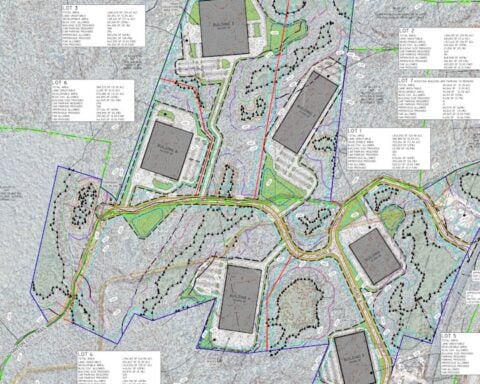




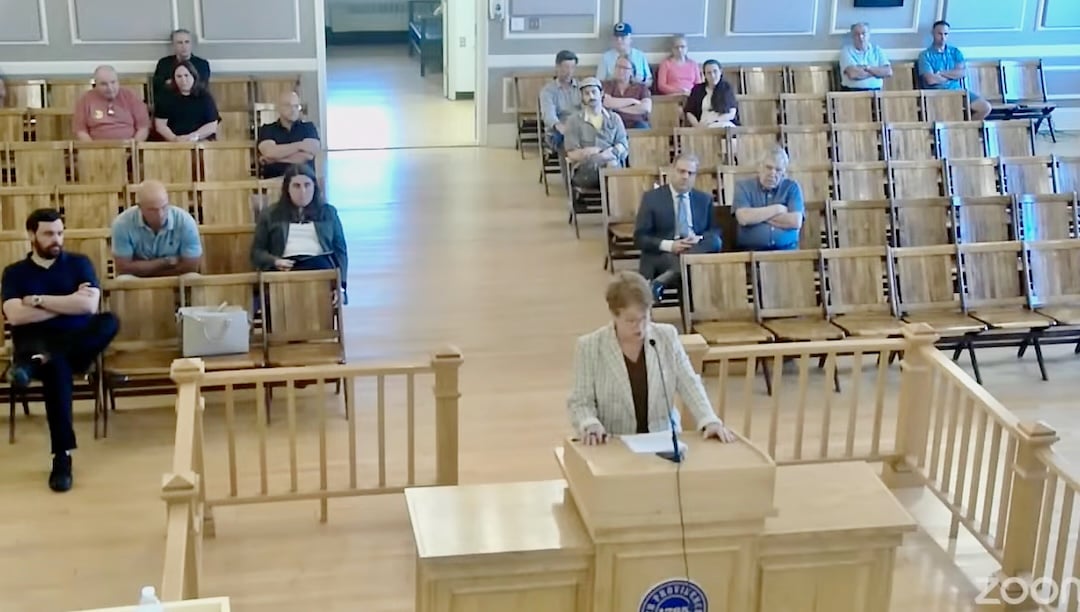
NORTH PROVIDENCE – Former advising attorney Kelley Morris Salvatore, Planning Director Brent Wiegand, and Town Solicitor Anthony Gallone insisted to the Town Council last week that the town followed the law in allowing changes to plans for a new storage facility on Douglas Avenue.
Council members, frustrated at the answers they received, said they weren’t satisfied with the discussion, and Council President Dino Autiello said they’ll meet next month to consider whether to hire outside legal counsel to seek out answers that are to their satisfaction.
Morris Salvatore emphasized that property owners’ rights are sacred under Rhode Island law, and sometimes ordinances aren’t written the way they’re intended. With local ordinances that aren’t very clear, she said, the only thing they can look at is documents, and that’s what they did.
At the special meeting on Sept. 16, the attorney criticized former Planning Board member Shane Piche for what she called his “defamatory comments” about her, saying even though she wasn’t invited to the meeting, she was not going to allow her name to be dragged through the mud. She said she gave good legal advice at every stage of this process, and it’s not her position to make final decisions.
Any insinuation that she directed Wiegand to approve a revised plan for the storage facility as a minor modification is absurd, said Morris Salvatore, emphasizing that she simply gave legal advise that he could.
Responding to Town Councilor Mario Martone’s question on whether conditions may be added on the use of land town, she said yes, but they must be clear and specific. A town may not rely on conditions based just on believing them to be inherent in approvals, she emphasized.
When Wiegand was reviewing the storage facility, she said, no specific conditions were found on number of buildings or height of buildings as part of the project. Wiegand, she said, had no authority to seek input from the council, and the council may not approve plans.
All zoning changes made in North Providence ruing 2017 were the same as the one for the storage facility, said the attorney, each employing the “exact same template language.”
Council President Dino Autiello then interjected to ask Morris Salvatore if she wanted to state for a fact that there was no discussion nine years ago about the project being made up of only one-story buildings, and not the three-story building seen going up now, and she responded that there was no mention of that in minutes from meetings or any other writing.
Morris Salvatore said Wiegand approved the final change to the current plans two years ago, after hearing her advise that it was a minor change. She said the proposed building at that time was further from neighbors with much more landscaping than originally planned.
The attorney said there was nothing sneaky about the process, as implied. She added that only those legally authorized to stop work on a project may do so, and that falls to Wiegand. Any demand by the council to stop the work puts the town and Wiegand personally at great risk, she stated, unless there are zoning violations.
As for assertions that she doesn’t want to defend the town in court, she stated, any town officials are free to vote no if they want to, as she said Piche “does all the time.” She said she would then do her best to defend any decision.
Conditions can’t be implied, said Morris Salvatore, and they must be in writing.
Autiello said he was told that a stop-work order was to be issued the previous Friday. He asked what changed from Friday to Tuesday, adding that he wonders how she would feel if a giant wall was rising in her own back yard, as neighbors of the storage facility are experiencing.
Morris Salvatore said she feels sorry for the neighbors, but this is a legal issue. The fact that there were no conditions meant Wiegand didn’t have the ability to stop the work.
The attorney said she’s sick and tired of people “trashing” her for doing the right thing, and Wiegand also did the right thing.
If councilors back in 2017 wanted specific requirements beyond what was approved, they could have done so, said Morris Salvatore, including by limiting the height of the building. One level, she said, can be 40 feet high. When property rights are in play, she said, “you’d better be specific.”
Councilor Ron Baccala said he felt this was a “bait-and-switch” situation on the part of the developer.
Councilor Steve DiLorenzo said the council has a responsibility to the people in the neighborhood who have been so impacted by this project, and he’s not comfortable saying simply that officials OK’d it and now they’re washing their hands.
The change from what was originally stated as multiple smaller storage buildings is a major one, said DiLorenzo, whether or not it’s legally defined that way. Morris Salvatore repeated that conditions need to be specific and clear.
Baccala then responded that the project went from “small to big,” but Morris Salvatore said the square footage of its footprint stayed the same.
In the end, she said, the project, whether it is liked or not, was a better one in planning terms, including when it came to the larger buffer between neighbors.
Baccala responded that most people in town don’t see this as a better project.
She said there was a case to be made that the project as once proposed could have featured nine buildings at 40 feet tall apiece, and they would be much closer to neighbors. She said she would prefer less pavement and for the facility to be away from her property.
Morris Salvatore said she understands the council is in a different position than she was in her role of giving legal advice, acknowledging that they’re trying to fix a tough situation.
Martone said he also listened to meeting tapes from nine years ago, and the square footage presented to the council was 40,000. That number is now 121,000, he said, and the larger number is not in the plans or the approval. If the town has no definition for a minor change, how could Wiegand determine that the change was minor, he asked?
Solicitor Gallone then rose to say that local rules determine whether something is minor, and the town has no definition on it. Local rules instead state that a minor change may be determined by the administrative officer, or referred to the Planning Board. The town would need an amendment to change how things are done, he said.
Morris Salvatore said a major change is defined, but a minor is “literally everything else.” She explained that with Cumberland’s subdivision regulations, for instance, creating an additional lot would be considered a major change.
Baccala said that to him, the massive wall going up is a major change. He gave the hypothetical situation of someone claiming they’re building a doghouse and instead erecting a 3-story home.
Wiegand said the developer received final approval under former Planning Director Dave Westcott, and the last versions of the plans were different that what was approved.
Morris Salvatore said the original submissions were only conceptual, as is standard, and the developer refined the plan through the steps of the process.
Baccala said “something this major” should never have been done like this, and it’s unacceptable for those living nearby.
Morris Salvatore said the plan never went from 40,000 to 120,000 square feet, calling that a “false premise” because she never heard that. She described what the council is doing as “Monday morning quarterbacking.”
Autiello then jumped back in, saying “no it isn’t” and accusing the attorney and town staff of working against them.
“This is ridiculous,” he said.
Morris Salvatore then responded that the council seems to want to put liability on town staff, and said she and Wiegand are protecting their decision based on the law.
When Autiello tried to shut down Morris Salvatore’s comments, she responded that he allowed Piche to slander her at a previous meeting. She said Piche doesn’t understand the law, which is why he generally voted against “things he didn’t like” when he was on the Planning Board. Piche called her incompetent, she said, accused her of nefarious activity, and challenged her ethics with no basis.
Further, she said, Piche’s suggestion that other developers are pillaging the town is “rich” coming from a man who ignores state and local legal procedures, has been cited for having no building permit, kept doing work when ordered to stop, has been cited for safety issues, and has failed to appear in Municipal Court.
Council attorney Charles Ruggerio then cut in to say that he appreciates Morris Salvatore’s desire to defend herself, but she should keep her comments to the issues surrounding the stop-work order. She then asked him why he didn’t have the same advice for Piche, and he responded that Piche’s comments were over quickly.
Morris Salvatore said she had a couple more sentences to offer, sharing about Piche’s violations for having no safety fencing on his property across from Town Hall and the property not being legally safe. The town, she said, completed repairs on his behalf, with costs borne by Piche. She said there’s still a “huge hole across the street from Town Hall” on Piche’s property.
Morris Salvatore then asked how the council allows someone to get up and talk about someone else as Piche did. When Piche then started speaking to her from the back of the room, she responded that she’ll sue him. He then shouted back about “North Elmore,” a reference to a previous project for a home approved on a tiny lot on North Elmore Avenue.
DiLorenzo asked Morris Salvatore if she advised Wiegand on 120,000 square feet being OK, and she said it didn’t come up. She said the building was proposed at up to 40 feet tall.
Baccala then sought clarification that 40,000 square feet wasn’t submitted on plans for the storage facility, and Morris Salvatore confirmed it, adding that this is why documents and written ordinances matter. She said it’s important to put changes on the town’s zoning map.
Martone said it seems as if Morris Salvatore and Wiegand are choosing to ignore a lot of words on paper in their interpretation of things. He cited the original applicants saying in a meeting that this proposed storage facility wasn’t speculative, and was actually their plan.
Attorney Tenessa Azar, representing the developer, reminded the council that they don’t have the ability to issue a stop-work order, and that there’s no action they can take against this project with an approved building permit and approved zoning amendment.
There may be things the town wants to change going forward, she said, but everything to this point has been according to the law and they can’t “unring a bell.” Everything was done by the book, she said, including Wiegand approving the minor change.
Martone asked about the difference between the $30 million claimed cost of the project and the $6.8 million put on the permit, saying that would be a difference in fees of $400,000. When Azar said that soft costs are included, Martone responded that $23 million in soft costs would be a lot.
Martone asked about an original promise from Kelly Coates to walk with neighbors and work with them to choose landscaping and fencing, and Azar said Coates is no longer affiliated with the project. Responding to questions on erosion, she emphasized that they can only plant greenery to the limits of their own property, and everything is monitored by and meets Rhode Island requirements.
A resident rose to say that it appears that the town is “screwed” on this matter, as he keeps hearing the word “discretion.” He said he wants to know if the word “diligence” was ever brought up, questioning how anyone could conceivably think that a 40-foot height could mean one story. At best, he said, that’s ignorant, and at worst, disingenuous.
Autiello then said he wanted to put the topic on the October agenda for review of whether to hire outside legal counsel, as it was clear that councilors wouldn’t be satisfied with the information they were receiving that night.